About Eurystomus gularis Vieillot, 1819
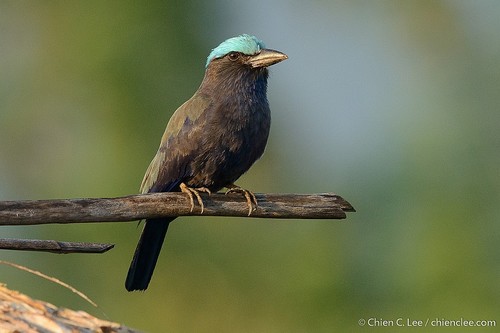
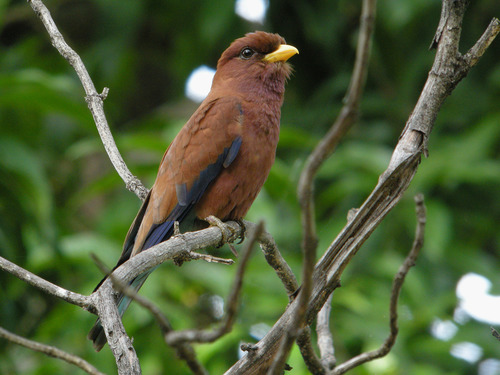
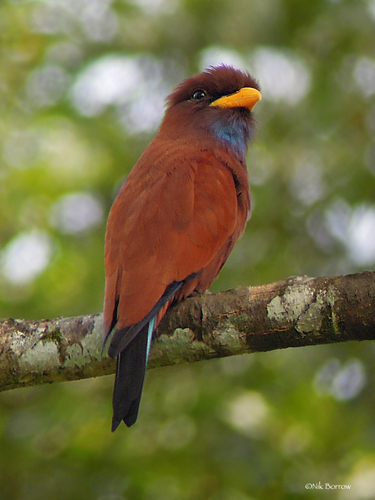
The blue-throated roller, Eurystomus gularis Vieillot, 1819, is a dumpy bird with a large head and thick neck that regularly visits tree tops. Overall it is a dark bird, primarily chestnut brown, with a bright yellow bill, a blue throat patch, a blue tail and purplish blue wings. Juveniles show blue coloring on their underparts. This is a rather long-winged roller that can have a falcon-like silhouette when in flight. It measures 25 cm in total length; males weigh between 82–117.5 g, while females weigh 88–108 g. This species occurs in western sub-Saharan Africa, ranging from Guinea to Cameroon, south to northern Angola, and east to south-eastern Uganda, and it is also found on Bioko Island. Blue-throated rollers typically stay high in tree tops and hunt above the canopies of primary and secondary rainforest, plantations, gallery forests, and relict forest patches in cleared areas. They prefer clearings, riversides and large emergent trees. Blue-throated rollers perch high up, either alone or in pairs, on bare branches, most often at the very top of the canopy. They frequently sit for long periods, and sometimes give out shrill chattering calls. When active, they hawk for insects in the air and aggressively defend their territory from other bird species. In the late afternoon, the birds gather in small flocks, often mixed with broad-billed rollers, to feed on winged ants and termites that emerge after rain. They feed on these insects in flight, acrobatically chasing them and eating them while on the wing. This feeding activity continues until dusk, and a single blue-throated roller may eat more than 700 insects totalling 40 g in weight. When breeding, the blue-throated roller is a territorial species. Both courtship displays and territorial defence involve noisy aerial chases. Its nest is an unlined cavity, normally placed around 10 m up the trunk of a tree at the edge of a clearing. Clutches contain 2 to 3 eggs. Egg laying has been recorded from February to March in Ivory Coast, February to April in Ghana, April and September in Nigeria, January in Gabon, and April and October in the Democratic Republic of Congo.