About Eurymela distincta Signoret, 1850
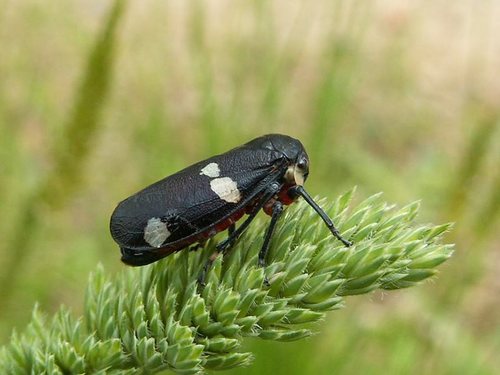
Eurymela distincta, scientifically described by Signoret in 1850, is a leafhopper species native to Australia. Adult males have a wedge-shaped body 10–12 mm long, while adult females measure 12–14 mm long. Its head is black, with cream or white maxillary plates. Both the pronotum and scutellum are black. The tegmen is black with a blue or purple tinge, marked with one to three white fasciae, and its costal margin is black. Legs are scarlet near the body, turning black further from the body, and the underparts of the body are entirely scarlet. E. distincta feeds primarily on two Eucalyptus species: bangalay (Eucalyptus botryoides) and apple box (Eucalyptus bridgesiana). It has also been recorded feeding on manna gum (E. viminalis), black gum (E. aggregate), and Camden woollybutt (E. macarthurii). Both nymph and adult E. distincta may be attended by up to 20 ants from the genus Iridomyrmex. These same ants also attend female scale insects of the species Eriococcus coriaceus and E. confusus, which infest the same host trees that E. distincta occupies. The ants consume the sugary excrement produced by the leafhoppers, which is known as honeydew. Field observations conducted in Bungendore, New South Wales, confirm that E. distincta reproduces once per year during the Australian spring. A single breeding pair occupies one individual tree. Mating occurs between September and October, and eggs are laid between October and December. Females cut a lengthwise slit into a branch measuring 1.5–3.8 cm in diameter, lay approximately 12 eggs inside the slit, and securely cover the eggs with a white frothy secretion. The eggs are slender and around 2 mm long. Larvae begin hatching in November and develop into adults by February. The vulnerable pronymph is transparent with red eyes, and it transforms into the nymph before it finishes emerging from the bark and its egg. The pronymph’s abdomen splits to allow the nymph to emerge; the new nymph turns black within around 15 minutes, after which it begins to feed. After emerging, nymphs gather in large groups at the base of new branch growth to feed. Nymph development goes through five instar stages. The first instar resembles a black spider with red eyes and a white belly. The second instar develops the red abdomen seen in adult leafhoppers, and has a more elongated body than the first instar. Documented populations of Eurymela distincta have been recorded in Sydney and Bombala (New South Wales), Nunawading (Victoria), and Hobart (Tasmania). Adult E. distincta generally hibernate through winter, though they will emerge on warm, sunny days. Summer hailstorms or very cold winters can kill this species. Two species of mymarid wasps and one dryinid wasp from the genus Anteon parasitize E. distincta eggs.