About Eurylaimus ochromalus Raffles, 1822
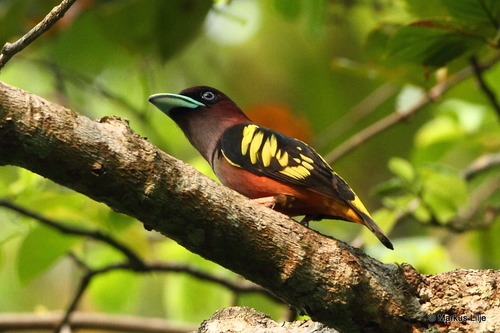
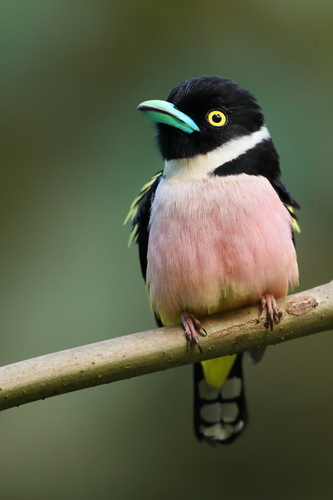
The black-and-yellow broadbill (scientific name Eurylaimus ochromalus Raffles, 1822) is a small, distinctive typical broadbill. It measures 13.5–15 cm (5.3–5.9 in) long and weighs 31–39 g (1.1–1.4 oz). Males have black heads and upperparts, a white collar, a black breastband, and prominent yellow markings on the back and wings. Their underparts are vinous-pink, fading to yellow towards the belly and undertail coverts, which are the tail feathers covering the underside of the tail base. The tail is black, with yellow spots on the middle feathers and whiter spots on the outer feathers. The iris is pale yellow; the bill is bright blue, with a green tip on the upper mandible and black edges. The base of the bill does not have bristles, which are present in some other broadbill species. The legs are reddish, with long tarsometatarsi. This species shows sexual dimorphism: females have a gap in the centre of the black breastband. Juveniles do not have a well-defined breastband, and have a pale yellow supercilium (a stripe running from the beak to above the eye) with grayish-white underparts. The reddish colours in the black-and-yellow broadbill's plumage come from the biological pigment 2,3-didehydro-papilioerythrinone, which is also found in the feathers of the banded broadbill, black-and-red broadbill, and Sarcophanops species. The yellow colour in its plumage comes from the carotenoid 7,8-dihydro-3′-dehydro-lutein, which is also present in the plumage of the banded broadbill. Like other typical broadbills, the black-and-yellow broadbill has a large, wide bill. This trait is thought to have first evolved in the common ancestor of all broadbills as an adaptation to an insectivorous diet. Its large, fleshy tongue helps manipulate objects inside the beak, letting it mash food against the inside of the beak to "chew" it. The black-and-yellow broadbill is distributed across Malaysia, Thailand, Myanmar, Singapore, and Brunei. In Indonesia, it occurs on the Riau Islands, the Lingga Islands, Borneo, Sumatra, Bangka Island, Belitung, and the Natuna Islands. It inhabits evergreen forest, mixed dipterocarp forest, freshwater and coastal swamp forests, heath forest, forest edges, secondary forest, and plantations including cocoa, rubber, and Albizia plantations. Its presence in secondary forest and plantations depends on these areas having large remnant trees. The species is mostly found in lowlands, occurring at elevations up to 700 m (2,300 ft) on the Malay Peninsula, 900 m (3,000 ft) in Sumatra, and 1,220 m (4,000 ft) in Borneo. Black-and-yellow broadbills have been recorded doing wing displays: they raise their wings, usually slightly over the back, then slowly open and close their flight feathers. Occasionally, displays are done with only one wing, followed by tail wags, or are accompanied by gaping displays where the beak is steadily opened and closed. These displays have been observed after singing, in response to playback, and after foraging. The species has occasionally been reported gathering in groups of up to five birds, though groups larger than pairs or pairs with young are not regular. Despite frequent confrontational behaviour like counter-singing, they are highly tolerant of other individuals in or near their territories, and aggressive behaviour such as chasing is seldom observed. However, pairs have been observed confronting each other to defend territory by bowing their heads and vocalising before attacking each other.