About Eurylaimus javanicus Horsfield, 1821
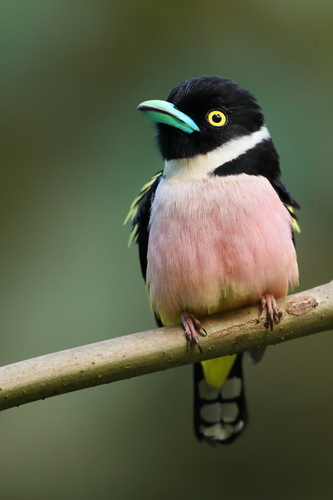
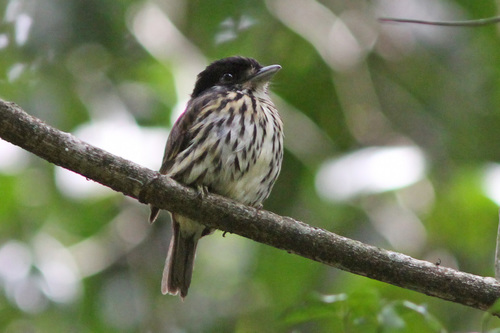
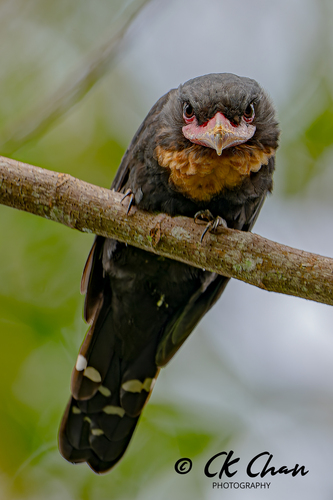
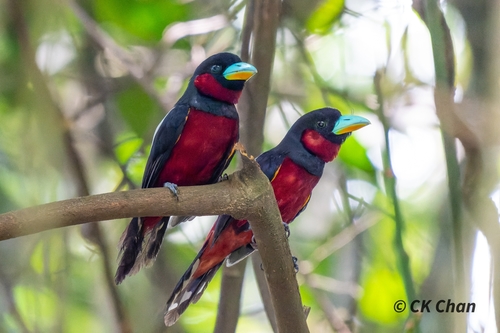
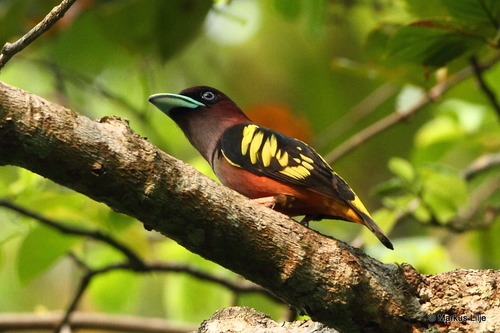
The banded broadbill (Eurylaimus javanicus Horsfield, 1821) is a striking large-bodied bird, measuring 21.5–23.0 cm (8.5–9.1 in) in length. For 10 adult pallidus subspecies specimens from the Malay Peninsula, weight ranges from 65.1–95.0 g (2.30–3.35 oz), with males weighing slightly more than females. When seen clearly, the species is unlikely to be confused with any other bird, though it may be mistaken for the black-and-yellow broadbill, which differs by its smaller size, black head, and contrasting white collar. Adult males of the nominate subspecies have a glossy purple-red head that turns black near the lores (the region between the eyes and beak) and the base of the bill. The chin, throat, and ear-coverts are slightly lighter, with a black band across the neck; this neckband is sometimes faint or absent in males from Borneo and Java. The top of the head is glossy maroon black and turns grey towards the back of the neck. The upper back is maroon-tinged dark brown; the rest of the back is mostly black, except for a central line of yellow streaks. Primary feathers are dark brown, with thin yellow edges that form a yellow line on the bend of the wing. The remaining wing-coverts are blackish, with yellowish markings. Secondaries have bright yellow edges along their outer margins that form a well-marked trapezoidal patch on the wing. Underparts are pale pinkish-violet to wine-red, with a grey tinge to the chin and upper breast and a solid grey breast-band. The tail is dark black with white spots on the underside, the undertail-coverts are pale yellow, and the rump has a variable black and yellow pattern. The brilliant turquoise blue beak is broad and hooked, edged green or black. This is one of the widest-billed broadbill species, with a thick, heart-shaped, wide tongue that lets it mash and "chew" its food, allowing it to consume relatively large prey. Irises are pale yellow in the nominate javanicus subspecies, and sapphire blue in all other subspecies; legs are pale pinkish-brown to light greyish-blue with dull black feathering. Females are similar to males, but can be distinguished by their lack of a neckband and greyer heads and underparts. Juveniles have pale brown heads, brown upper backs, dark brown wings, and black tails. They have a distinct yellow supercilium (a line above the eye) that widens towards the back of the neck to form a broken collar, and the ear-coverts have narrow yellow streaks. The upper back has irregular yellow spots, and the back and rump are largely yellow. Juvenile wings have yellowish markings identical to those of adults. The throat is yellowish with pale dark streaks and is separated from the breast by a yellowish-white strip; the rest of the underparts are pink-tinted yellow. Juvenile bills are orangish-brown. As juveniles mature, the yellow on their bodies is gradually replaced with purple-pink, starting with the head and side of the neck. In Malaysia, moulting has been observed in all months except January and February, and peaks from May to August. The primary feathers closest to the body are moulted first, and those further from the body moult later. The reddish colours in the banded broadbill's plumage come from the biological pigment 2,3-didehydro-papilioerythrinone, which is also found in the black-and-yellow broadbill, black-and-red broadbill, and Sarcophanops species. The yellow in the species' plumage comes from the carotenoid 7,8-dihydro-3′-dehydro-lutein, which is also present in the plumage of the black-and-yellow broadbill. The banded broadbill is found in Mainland Southeast Asia and the Greater Sunda Islands. In Indochina, it occurs in southern and central Vietnam, most of western and southern Thailand, most of Cambodia excluding the Tonlé Sap, southern and central Laos, and the Tenasserim Hills and Karen Hills in southeastern Myanmar. In the Greater Sundas, the species inhabits Sumatra, Borneo, Java, Belitung, Bangka Island, the North Natuna Islands, and the Riau Archipelago. It went locally extinct in Singapore around 1928; reports of its presence on Penang Island are unconfirmed. It is usually non-migratory, but records of one or more individuals living in a patch of secondary forest on a former rubber plantation in Kuala Lumpur over three years indicate the species wanders when it loses its usual habitat. The species lives in several forest types, including primary forests, regrown selectively logged forests, peat swamp forests, high-altitude heath forests, freshwater swamp forests, forest edges, rubber plantations, and Falcataria falcata groves. On the mainland, it is most common in evergreen and mixed deciduous forests, but is also seen in adjacent gardens, villages, and secondary forests. On Java, it is usually found at forest edges, especially on mountain slopes. Although it is mainly a lowland species, the banded broadbill occurs up to elevations of 1,050–1,100 m (3,440–3,610 ft) on the Malay Peninsula and Sumatra, 1,100 m (3,600 ft) in Laos, 1,200 m (3,900 ft) in Cambodia, and 1,220 m (4,000 ft) on Borneo. On Java, it is typically found at altitudes of 485–915 m (1,591–3,002 ft), but sometimes occurs as high as 1,500 m (4,900 ft). Despite the banded broadbill's distinctive and noticeable colouration, it is generally hard to observe due to its lethargic habits, and is usually only detected by its loud song. It performs wing and gaping displays similar to those of the black-and-yellow broadbill. Wing displays include raising the wings slightly above the back and then slowly opening and closing the flight feathers, and are performed after singing, after foraging, or in response to playback. Displays may use just one wing, and are sometimes accompanied by a tail wag. Gaping displays are carried out by opening and closing the bill in measured movements without making any sound. These displays are performed both alone and when other banded broadbills are present, and have been observed near nests. They are also sometimes accompanied by soft calls.