About Eurygaster integriceps Puton, 1881
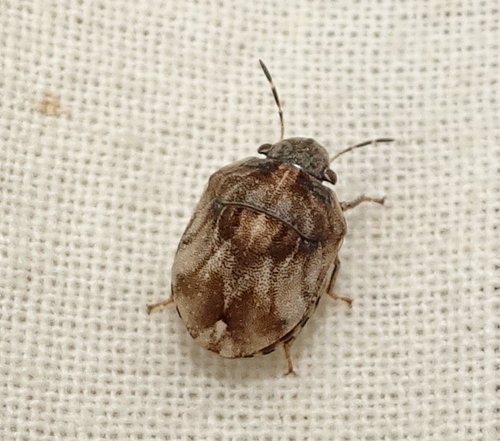
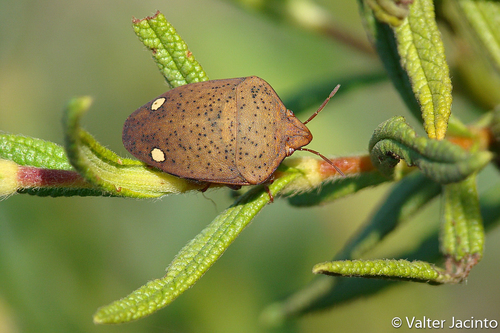
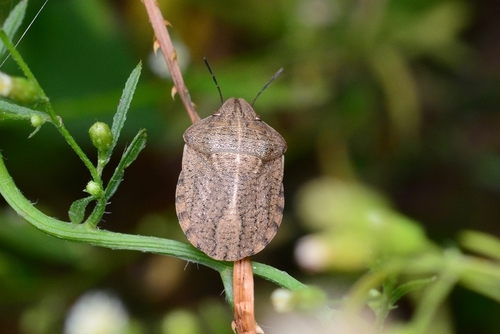
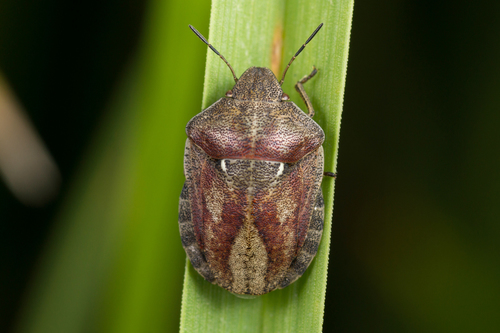
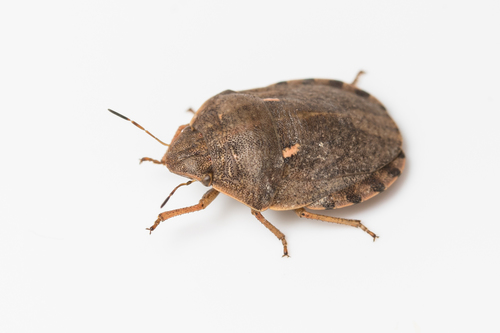
Morphology and biology: The sunn pest (Eurygaster integriceps) shows variable body color, but is most commonly light brown. It has a broad oval body that is approximately 12 millimetres (0.5 in) long. Its wide, chitinous scutellum completely covers the wings and the entire abdomen. Adult sunn pests live for around one month, during which females lay between 28 and 42 eggs in total. Eggs are laid in batches that each form two neat rows of seven eggs, placed on the undersides of leaves and on the stems of host plants, and sometimes on weeds. Eggs take 6 to 28 days to hatch. After hatching, nymphs moult five times while feeding on the leaves, stems and ears of cereal crops over the next 20 to 45 days. Their fastest growth occurs at air temperatures between 20–24 °C (68–75 °F). Second and third instar nymphs have a pale abdomen, with a dark head and thorax. Fourth instar nymphs have developing rudimentary forewings, while fifth instar nymphs also have rudimentary hindwings. Distribution: The sunn pest is distributed across Northern Africa, and Southeastern Europe including Albania, Greece, Bulgaria and Romania. In Asia, it is found in Turkey, Syria, Lebanon, Iran, Iraq, Afghanistan and Pakistan, as well as in the Central Asian republics of Kazakhstan, Kyrgyzstan, Tajikistan, Turkmenistan and Uzbekistan. Within Russia, the species has spread to the central and Volga Basin regions, the Northern Caucasus, the Chelyabinsk region and Bashkortostan. Ecology: Most adult sunn pests overwinter in leaf litter in woodlands, though some take shelter among coarse vegetation. When temperatures reach approximately 13 °C (55 °F), the adults move to cereal crops, begin feeding on stems, leaves and developing seed heads, mate, and lay their eggs. The sunn pest produces only one generation per year, so adults and nymphs can often be found feeding together on ripening grain. If the insects are not fully developed by the time the crop is harvested, some nymphs and young adults will feed and mature on fallen grain and other crop residues before flying to their overwintering sites. In Syria, sunn pests spend approximately nine months in hibernation.