About Eurydema oleracea (Linnaeus, 1758)
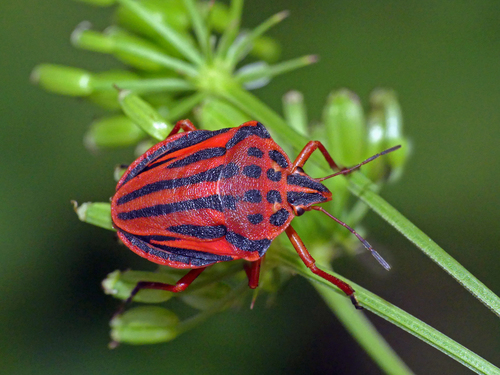
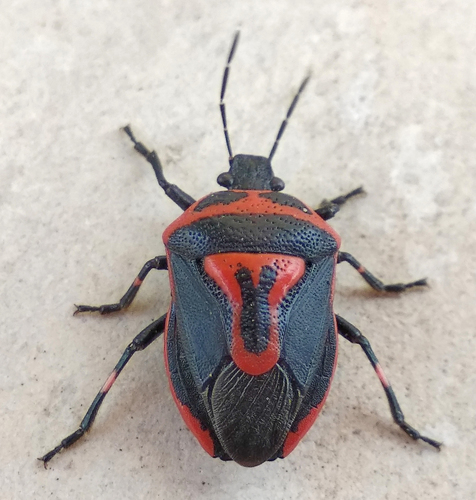
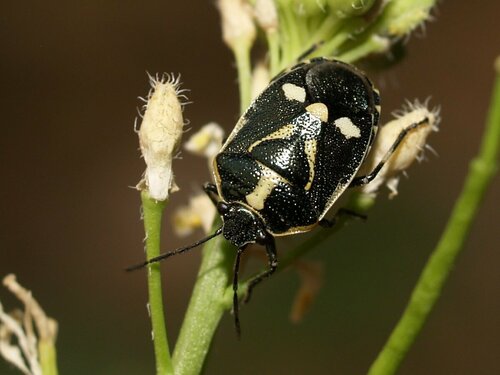
Eurydema oleracea (Linnaeus, 1758), commonly called the rape bug, has a shiny, flat dark body that measures approximately 5–7 mm (0.20–0.28 in) long and 4 mm (0.16 in) wide. Its body has a dark base color covered with red, yellow, cream, white, or orange markings. There is an oval spot on the top of the mesonotum, one oval spot on each elytron, and a longitudinal stripe on the prothorax. In young adult individuals, these spots are yellow; as bugs age, the spots change to white or red. At the same time, the abdomen's color shifts from buff to black. These age-related color changes in adult (imago) individuals are linked to the bugs' sexual maturation, and they often occur in diapausing adults when they become active again. The species' eggs are cylindrical, buff-colored with a dark pattern. Females lay eggs in batches on the stems and inflorescences of host plants; most batches contain around twelve eggs arranged in two neat rows. Each female lays a total of sixty to eighty eggs over a period of four to six weeks. Nymphs are pale gray, with a dark-brown pronotum and dark spots on the dorsal side of the abdomen. Nymphs moult five times before reaching adulthood. Both adults and nymphs live openly on host plants. Adults overwinter by hibernating in leaf debris at the edges of woods or in bushes. This species has a wide distribution across the eastern Palearctic realm. It occurs in Western Europe (excluding northern Scandinavia), Kazakhstan, most of Russia, the mountainous regions of west and central Asia, and North Africa. Overwintering adults emerge in late spring. In the northern part of the species' range, there is one generation per year, while southern areas have two generations per year. Both adult and nymph rape bugs feed on a wide variety of cruciferous plants (Brassicaceae), feeding mainly on the plants' flowering structures. Among cultivated crops, the bugs damage cabbage, radish, turnip, rutabaga, horseradish, and rape. They can also complete their development on many species of wild cruciferous plants. Natural enemies of Eurydema oleracea include multiple species of parasitoid wasps from the family Scelionidae, several species of predatory bugs from the family Nabidae, the rare parasitic fly Clytiomya continua, and some spiders and ants. This pest can be controlled through crop rotation, destruction of cruciferous weeds, and the use of insecticides.