About Eurycotis floridana (Walker, 1868)
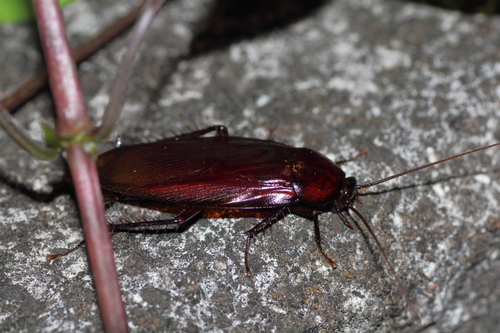
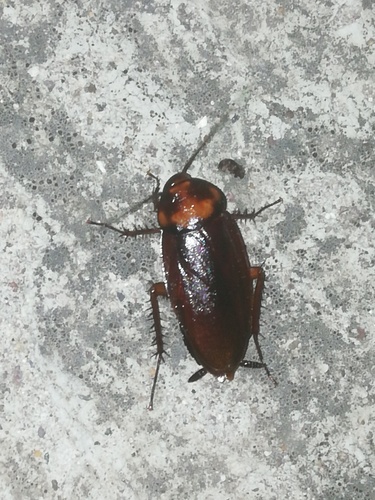
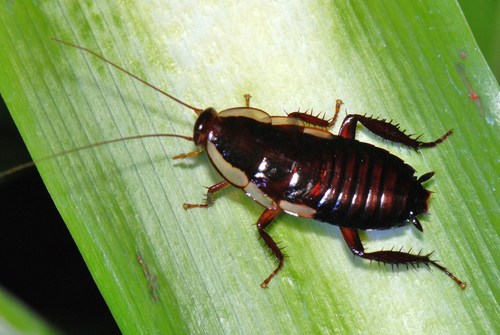
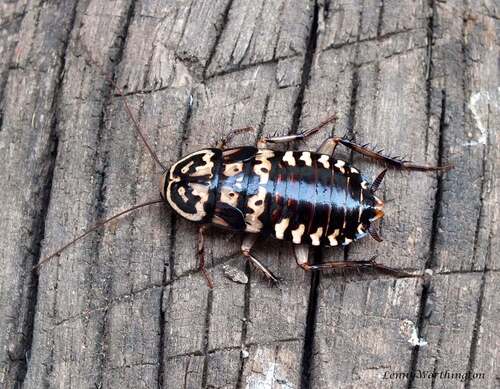
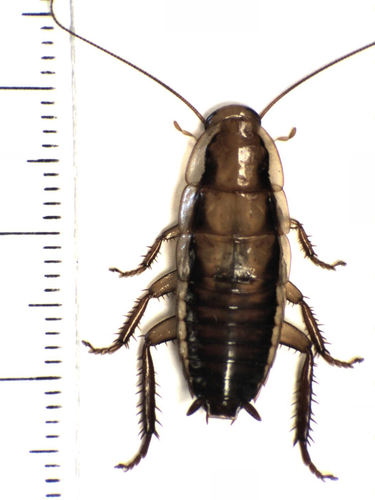
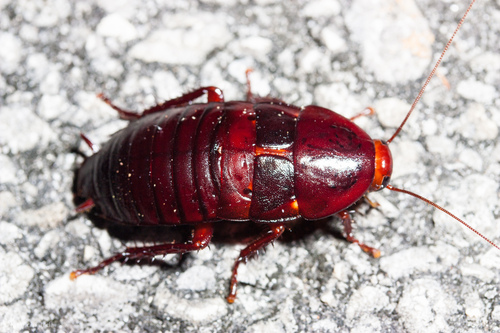
The Florida wood cockroach, Eurycotis floridana, is typically dark to blackish brown, and turns reddish brown shortly after molting. Its fore wings, called tegmina, are very short and only extend just past the mesonotum — the dorsal plate located directly behind the pronotum — and it has no hind wings. Adult individuals usually measure between 30 and 40 mm (1.2 to 1.6 in) long. The largest recorded specimen, which won a Florida cockroach size contest, measured 62 mm (2.429 in). This species looks very similar to the female oriental cockroach (Blatta orientalis), and casual observers often mistake the two for one another. The species' dark brown egg case, called an ootheca, is 14–16 mm (0.55–0.63 in) long, holds 21 to 23 eggs, and has indentations marking the position of each egg. Natural habitats for this species include holes in dead trees, stumps, and woodpiles, cavities under bark, and sometimes leaf litter. It occasionally enters buildings, but usually only becomes established in non-living areas of structures. It is not uncommon for these palmetto bugs to settle in attics, where they leave their characteristically large droppings and occasional body parts from dead individuals. This species has been recorded in the West Indies and a limited southeastern region of the United States, which includes the state of Florida, and coastal areas of Alabama, Georgia, South Carolina, Mississippi, Louisiana, southern and southeastern Texas, and southeastern North Carolina. It is classified as adventive, but not established, in the Canadian provinces of Newfoundland and Labrador and Nova Scotia. For reproduction, males can mate around 18 days after maturing. Females produce a new ootheca approximately every 8 days, starting around 55 days after maturing. Oothecae are buried in soil or decaying logs, and hatch after 50 days at temperatures of 30–36 °C (86–97 °F). Asexual reproduction, called parthenogenesis, can occur, but the resulting nymph clones do not develop into adulthood.