About Eurycea wilderae Dunn, 1920
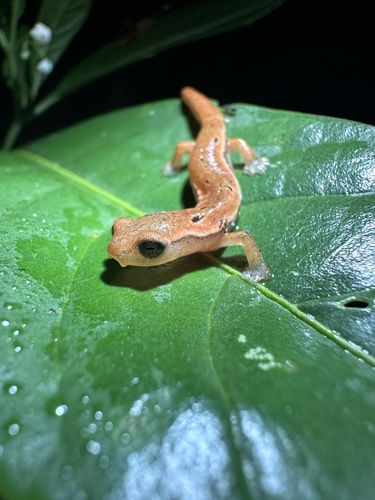
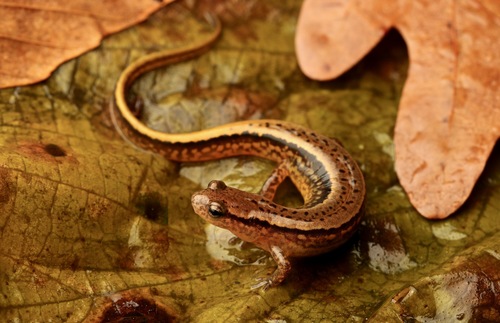
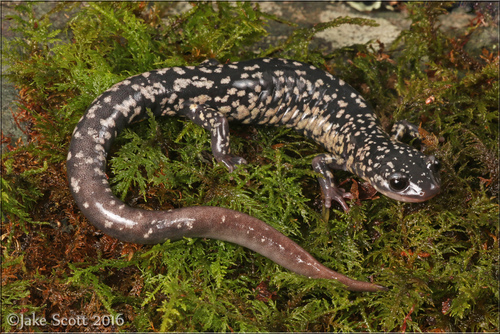
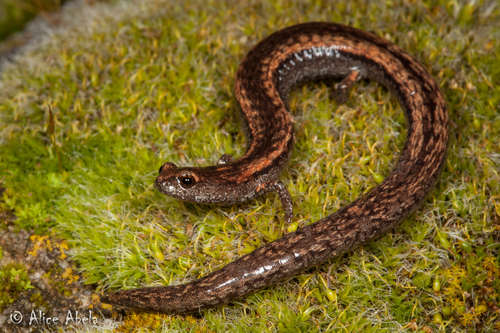
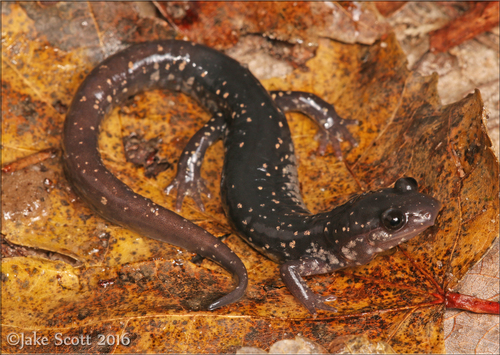
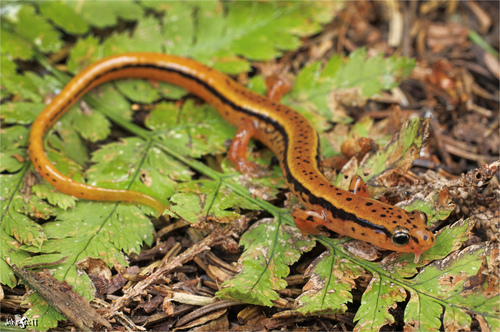
Morphology: The Blue Ridge two-lined salamander (Eurycea wilderae) measures between 2 3/4 to 4 1/2 inches (7 to 10.7 cm) in total length. Its base color ranges from bright yellow and yellow-orange to orange. It has two black dorsolateral lines, which usually break into separate dots or blotches around the middle of the tail. Scattered black dots are often present on its back. The species has a relatively long tail, which makes up 55 to 60% of its total body length. It generally has between 14 to 16 costal grooves, with count varying by elevation: 14 costal grooves are most common at lower elevations. Nasolabial grooves, also called cirri, are common in this species. Dorsally, larvae are typically pale-yellow to yellow-green. Distribution and habitat: This species is found in the southern Appalachian Mountain range. Within this region, it occurs along streams and in forested habitat. Whether individuals are found in more terrestrial or aquatic habitat depends on the mating season. It is not well-documented whether this species migrates beyond moving between terrestrial and aquatic habitats. As a lungless salamander, it requires cool, moist environments. Suitable streams for this species contain submerged substrate for egg-laying. When not breeding, individuals burrow, most often under logs and leaf litter. Depending on habitat conditions, population densities can reach over 100 individuals per square meter. Reproduction: The Blue Ridge two-lined salamander uses external fertilization. Oviposition typically takes place in late winter or early spring. Females deposit eggs under submerged rocks, logs, or leaves in water, and guard the eggs until they hatch. Newly hatched individuals have external gills, and remain fully aquatic larvae for approximately two years before metamorphosing into adults. The timing of larval metamorphosis depends largely on temperature and food availability: larvae exposed to higher temperatures metamorphose sooner, while larvae with greater food access grow much larger and delay metamorphosis for longer. Evidence indicates direct development was the ancestral developmental mode for this lineage, and the current metamorphic life cycle is an example of metamorphic deceleration. This species shows sexual dimorphism between two distinct male morphs: searching males and guarding males. Searching males possess cirri, mental glands, and protruding premaxillary teeth, which are adapted for locating and courting females in terrestrial habitats. Guarding males lack these traits, and instead have seasonally enlarged jaw musculature adapted for defending females at aquatic nesting sites.