About Eurycea guttolineata (Holbrook, 1838)
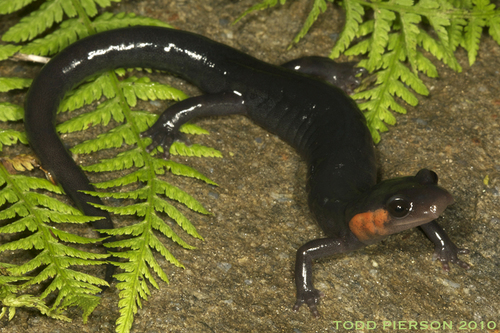
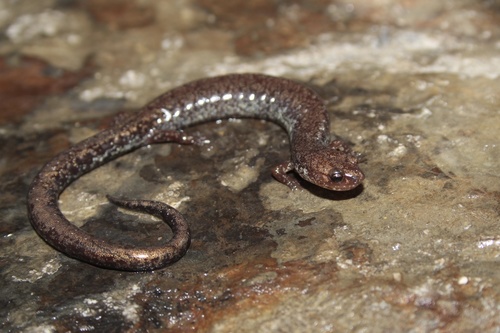
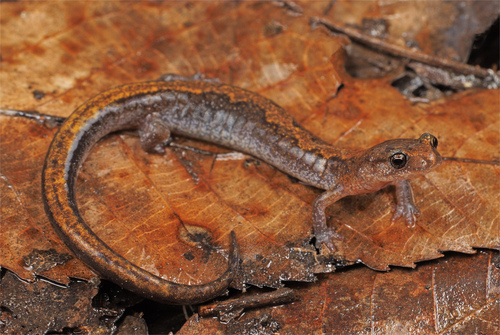
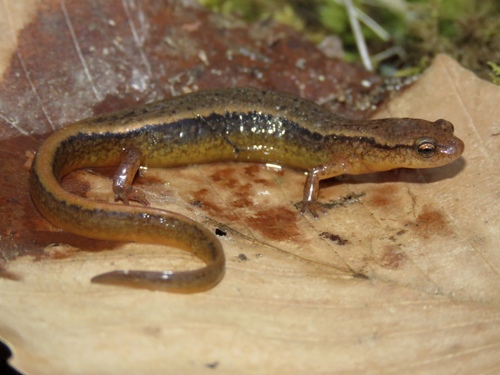
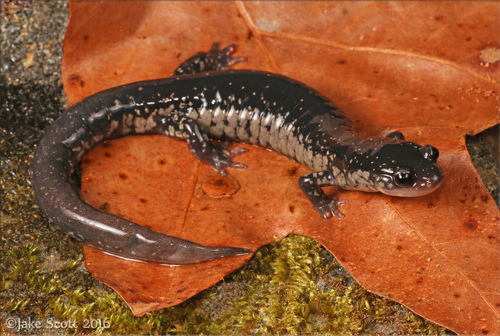
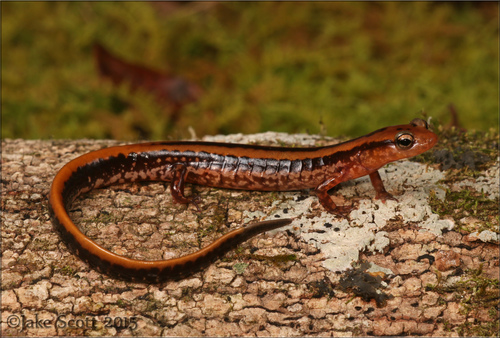
Eurycea guttolineata, commonly called the three-lined salamander, is a mid-sized, slender stream salamander. Adult individuals measure between 10 and 15.9 cm in total length. Their base color ranges from tan to light yellow, with three black longitudinal stripes that run from the eyes all the way down the body to the tip of the tail. This species has 13 to 14 costal grooves, which support cutaneous respiration. The tail makes up approximately two-thirds of the salamander's total body length, making it very long. The ventrum (belly) has bold black and white marbling patterning. This species is distributed across much of the southeastern United States. Its range covers the Appalachian Mountains from Virginia and Tennessee, extending south through the Carolinas, Georgia, Alabama, and Mississippi to the Gulf Coast, and includes eastern Louisiana and western Florida. Its natural habitats are forested floodplains, ditches, streamsides, and seepages. During wet weather, it may move into wooded terrestrial habitats. It is not uncommon in habitats that meet its needs. Some subpopulations have likely been extirpated due to the loss of bottomland hardwood forests. Compared to other salamander species, Eurycea guttolineata can occupy ecological niches and use habitats closer to roads. Breeding occurs in slow-moving bogs and streams. Newly hatched larvae are generally around 10 to 13 mm in length, and undergo metamorphosis once they reach a snout-to-vent length of 22 to 27 mm. Metamorphosis begins with the reduction of labial folds, development of eyelids, and resorption of the tail fin. The process completes with the loss of gills and gill slits, alongside changes to pigmentation. The larval stage typically lasts 4 to 6 months. Extensive research on the effects of elevation on the larval stage has found that larvae at lower elevations complete metamorphosis sooner, while larvae at higher elevations experience delayed metamorphosis, mostly due to overwintering. As a semi-aquatic salamander in the Plethodontidae family, females enter cooler water in late autumn and winter to lay eggs. Average clutch size for females is 12 to 14 eggs.