About Eurycea chamberlaini Harrison & Guttman, 2003
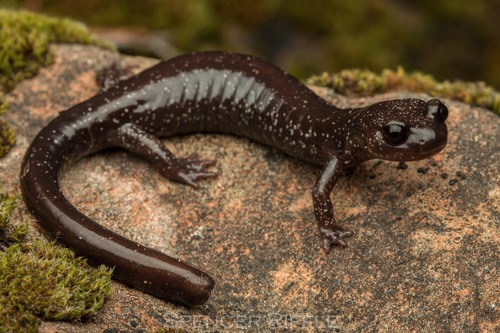
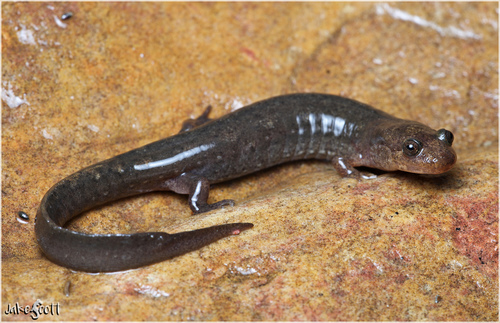
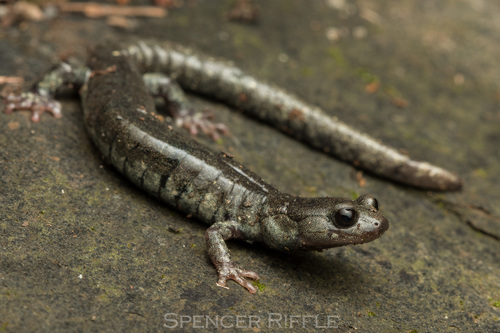
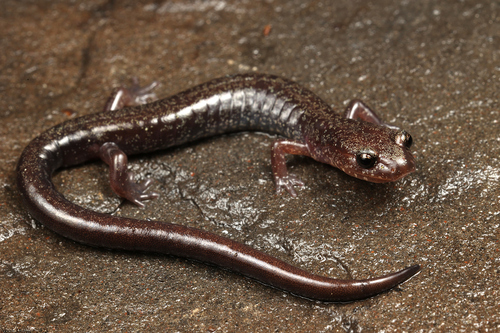
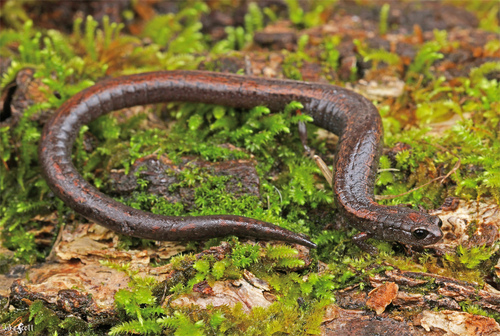
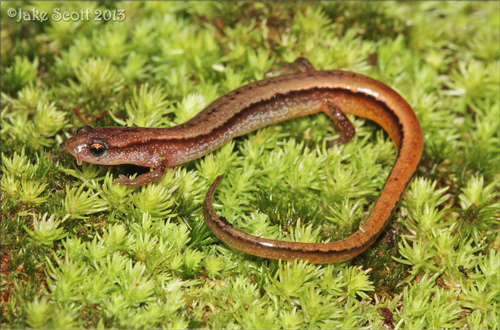
Chamberlain's dwarf salamander (Eurycea chamberlaini) is a very small species, with an average total length of just 2.5 centimetres (1.0 in). Compared to the closely related Eurycea quadridigitata, which it is often confused with, E. chamberlaini is lighter brown in color, has an unspotted yellowish underbelly, and is smaller on average. It can also be distinguished from E. quadridigitata by having only 16 coastal grooves. Along with E. quadridigitata, E. chamberlaini is the only salamander found in North Carolina that has four toes on each hind leg. E. chamberlaini has a yellowish-brown stripe running down its back (dorsum), which is bordered by a black or brown stripe on each side. The tail of an adult typically makes up 50 to 60% of the individual's total length. Females of this species are usually larger than males. The overall population structure of E. chamberlaini appears similar to other coastal plain salamander species, with a statistically significant difference in mean snout-vent length between mature females and mature males, with females being larger. Eurycea chamberlaini is found only in North Carolina and South Carolina in the United States. Its range includes the Piedmont region of both states, the Upper Coastal Plain of South Carolina, and the Central Coastal Plain of North Carolina; in North Carolina, it occurs mostly in the southern part of the Coastal Plain, and generally occupies areas separate from where E. quadridigitata is found. Its natural habitats are temperate forests, rivers, and freshwater marshes. It occurs most often in lotic (flowing water) environments, and prefers areas around streams or seepage from springs and ponds; some populations are found in lentic (still water) areas such as floodplains, but lotic habitats are preferred. In North Carolina, records show the species is found in bottomland swamps and marshy areas, where it occurs in leaf litter, within moss, or under other cover objects. As an endemic species of the Carolinas, E. chamberlaini is highly susceptible to human-caused impacts including habitat loss, habitat encroachment, and climate change.