About Eurycea bislineata (Green, 1818)
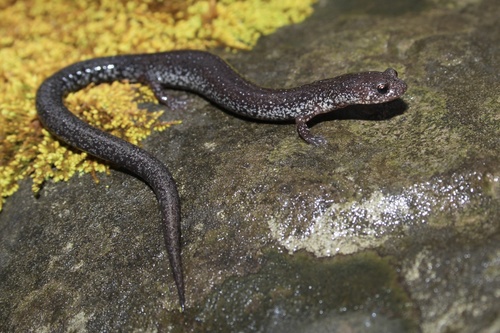
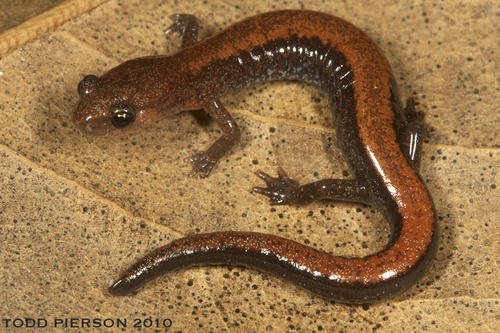
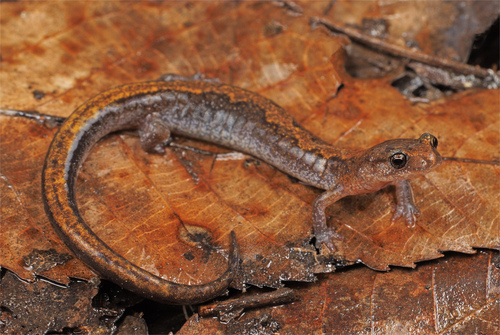
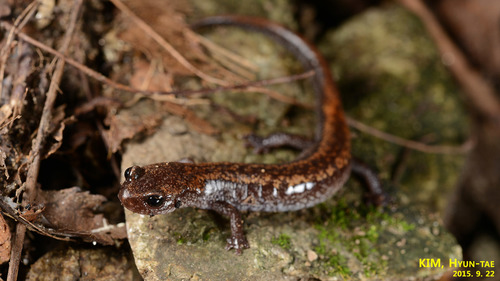
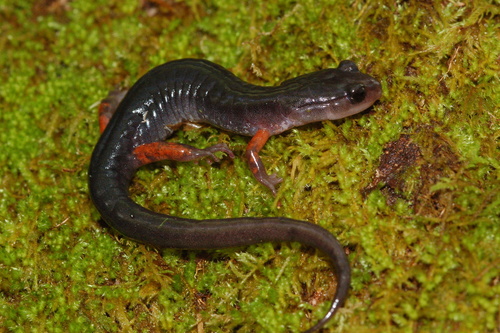
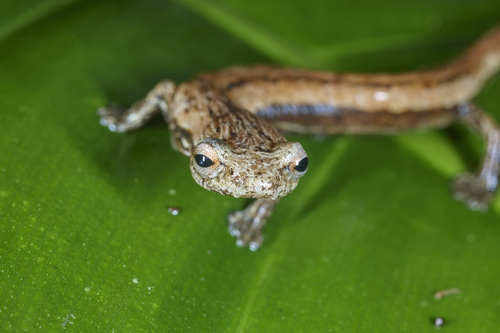
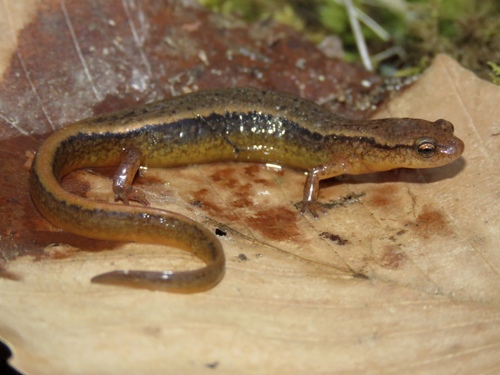
Eurycea bislineata, commonly called the northern two-lined salamander, is a small salamander species. Adults measure 65–120 mm in total length, and have yellow or yellowish-brown bodies marked with two black stripes running down the back; these stripes typically break up after the base of the tail. Flanks are mottled grayish or brown, while the belly is pale yellowish and nearly transparent. This species has four toes on each front foot and five toes on each hind foot, with 14–16 costal grooves along the sides of the body. Northern two-lined salamanders prefer small rocky streams or seeps in forests, but can also occur in moist areas far from running water. Some records indicate the species may also be found on the stony shores of small lakes and rivers. Its range covers most of northeastern North America, extending through central and southern Quebec, New Brunswick, and northeastern Ontario in Canada, and through the northeastern United States from central Virginia and Ohio northward to the Great Lakes. Compared to many other species in the genus Eurycea, E. bislineata has a large geographic distribution. The reproductive strategy of this species begins with an elaborate courtship, which can occur between September in southern parts of the range to May in northern parts. Descriptions of this courtship come from captive observations made by Noble in 1929: the male first becomes restless as he searches for a female. When he finds a female, he lifts her by pushing his snout under her cloacal region or chest, then bends his body laterally around her snout to hold a distinct posture. The pair can remain in this position for an hour or more. The female eventually slips out of this posture and straddles the male's tail with her fore limbs, pressing her chin against the base of the male's tail. The male slowly and exaggeratedly undulates his tail from side to side, while the female moves her head from side to side, moving alternately away from and back to the male's tail. This tail-straddling walk can last over an hour, after which the male deposits a conical spermatophore 2.5 mm in height with a colorless, tapering stalk, and the female walks over the spermatophore to either accept or reject the male's sperm. This species shows sexual dimorphism in the shape of premaxillary teeth: breeding males have unicuspid, elongated teeth, while females have shorter, bicuspid teeth. The enlarged male teeth abrade the female's skin to introduce secretions from the male's mental gland (located on the chin) into her circulatory system, which stimulates mating. Before laying eggs, the female searches for a suitable oviposition site in the stream. Nests are most often placed under rocks, and sometimes under logs or potentially vegetation. Data from research on the closely related species E. cirrigera in the Georgia Piedmont found 65% of nests were under cobbles measuring 2.5 to 30 cm, 16% were under boulders larger than 30 cm, and 19% were under experimentally added 30×30×1 cm slate tiles. To deposit eggs on the underside of a rock, the female flips onto her back to make cloacal contact with the substrate. Laying each individual egg takes three minutes this way, and laying a full clutch can take up to several hours. Freshly laid eggs are white or pale yellowish, with each egg measuring 2.5–3 mm in diameter and surrounded by two distinct membranes. Communal nesting by northern two-lined salamanders has been documented multiple times across different localities including New York, Ontario, and likely Ohio. When larvae hatch, they are gilled and approximately 10 mm long. They stay in slow-moving pools, or less often hide in crevices between rocks and boulders in swift-flowing streams. Larvae do not start feeding until their yolk sacs are reabsorbed; once feeding begins, they prowl the stream bottom to eat benthic invertebrates. Typical prey for northern two-lined salamander larvae includes chironomid larvae, other dipteran larvae, stonefly larvae, cladocera, and copepods. Larvae have many predators, including fish, crayfish, and other larger salamander larvae such as the northern spring salamander (Gyrinophilus porphyriticus). The length of the larval period varies by latitude. In the southern portion of the species' range, such as New York, metamorphosis occurs when larvae reach 50 mm in total length, or at two years old. Further north, in areas such as Quebec and likely Ontario, metamorphosis occurs when larvae reach nearly 70 mm in total length, or at three years old. Larvae overwinter in deeper pools that do not freeze. Once larvae reach their maximum size, they undergo metamorphosis. Northern two-lined salamanders reach sexual maturity at three to four years old. Adults and juveniles are mostly found along stream edges, hiding under rocks and other debris during the day. Some individuals undergo seasonal migration, though not all do. Research from Quebec indicates a postbreeding migration into forest habitat occurs in June, with adult salamanders sometimes moving more than 100 m away from the stream. Newly metamorphosed juveniles also migrate to leave the stream, but tend to stay closer to the water. About 75% of individuals that disperse more than 100 m into the forest do not return, and are thought to have been eaten by predators. Most above-ground movement happens after dark and during wet weather, with juveniles and adults usually moving in the first hour after dark as they emerge from their retreats to forage along stream banks or the forest floor. Adult diets are broader than larval diets because adults can forage across both terrestrial and aquatic habitat. Recorded adult prey includes wood roaches, arachnids, worms, isopods, millipedes, centipedes, beetles, snails, springtails, flies, hymenopterans, sowbugs, midges, mayflies, annelids, stonefly nymphs, caddisfly larvae, thrips, and rarely trout fry. Adult population density varies based on habitat quality. Adults are territorial, so low resource availability leads to lower population density. In some populations, density is as low as 0.02–0.04 animals per square meter, while in other areas localized densities can reach as high as 11 individuals per square meter. In cold climates, adults overwinter up to 80 cm deep in the soil of stream banks; in southern regions, adults may remain somewhat active and continue feeding through the winter.