About Eurybia surculosa (Michx.) G.L.Nesom
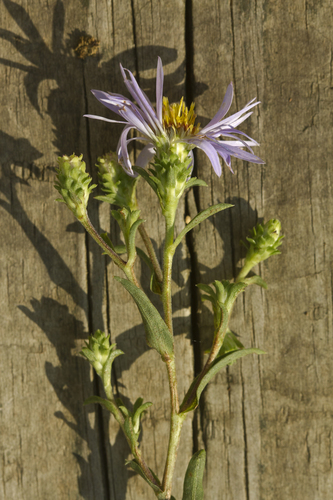
Eurybia surculosa, commonly called creeping aster, is an herbaceous perennial plant in the family Asteraceae. It was previously classified under the genus Aster. This species is native to the eastern United States, where it grows in sandy soils along the coastal plain. When Eurybia compacta is present in an area, Eurybia surculosa occurs farther inland, in the southern Appalachian Mountains and the Cumberland Plateau. While the species is not seriously threatened overall, it is locally endangered in Ohio, Virginia, and Alabama. Its flowers have bluish violet ray florets and pale yellow disc florets, which eventually turn purplish. Flowers emerge in summer and persist into the fall. Eurybia surculosa is native to the eastern United States, where it occurs both along the coastal plain (especially in the northern part of its range) and in the southern Appalachians. The two species E. surculosa and E. compacta do not tend to coexist; where E. compacta is present, E. surculosa is usually restricted to inland areas and mountains. Isolated populations of E. surculosa are found in the northern states of Massachusetts and Connecticut. Its range is continuous from Delaware and Maryland south through Virginia and the Carolinas to Georgia. To the west, it occurs in Alabama, Tennessee, Kentucky, and Ohio, and is absent from West Virginia. It typically grows at elevations between 200 and 1,500 meters (660 to 4,920 feet), in both dry and wet sandy soils. Its known habitats include open areas, pinelands, oak scrub, clearings, bogs, and roadsides.