About Euryale ferox Salisb. ex K.D.Koenig & Sims
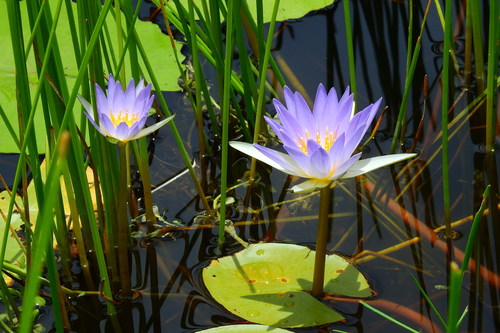
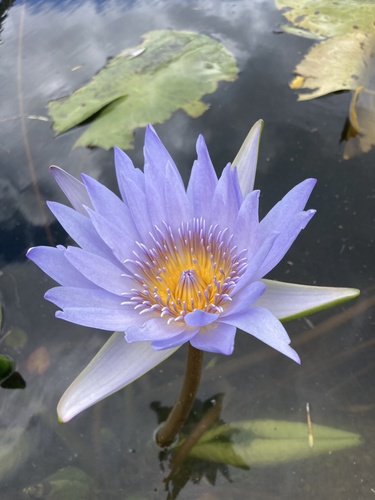
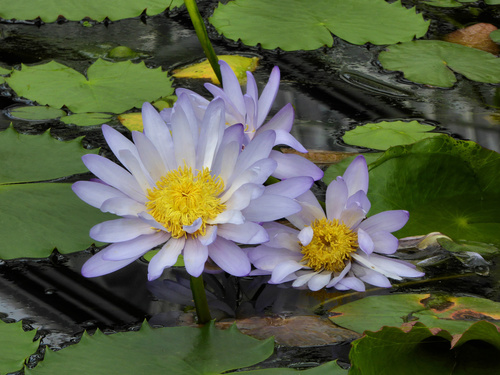
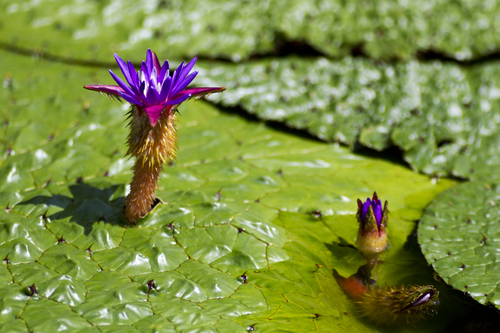
Euryale ferox Salisb. ex K.D.Koenig & Sims is an aquatic perennial plant that grows in freshwater ponds, preferring rich underwater soil. During the growing season, it cannot tolerate shade or cold, but dormant winter plants are unharmed by severe cold. Its leaves are large, round, peltate, and are often over 1 m across, sometimes reaching 2.7 m in diameter. The top of the leaf has a distinctive puckered texture, the leaf stalk attaches to the center of the leaf underside, the leaf blade is deep green, and its veins are purplish. Both stems and leaves are covered in sharp prickles. The flowers are 5 cm in diameter, with violet outer petals and white inner petals, and they often grow through the leaves. The fruit is a 5–10 cm diameter spiny capsule that holds many seeds with a spongy texture. This species is native to an area stretching from northern India to Taiwan, and through China, Korea, and Japan to far eastern Russia. In 2022, it was recorded as naturalized in Serbia, likely dispersed to the site from botanical garden plants by migrating birds. Euryale ferox can self-pollinate: pollen is released before the flower opens. Most of its flowers are cleistogamous, meaning they do not open for cross-pollination, though a small number of normally opening chasmogamous flowers do occur. Its chromosome count is n = 29, the nuclear genome size is 870.42 Mb, and the chloroplast genome is 159930 bp long. Both the seeds and petioles of Euryale ferox are used as food. In 1990–1991, more than 96,000 hectares of land in Bihar, India were dedicated to cultivating the local variety of this plant, whose nuts are called Mithila Makhana. India is the world's largest producer of Makhana, also called fox nut, with over 90% of global cultivation concentrated in Bihar's floodplain regions, particularly the districts of Darbhanga, Madhubani, and Purnia. Makhana has become a key agricultural export commodity, valued for its nutritional profile and granted geographical indication. In northern and western India, Euryale ferox seeds are commonly roasted or fried like popcorn, and are also used to make a porridge or pudding called kheer. The seeds are additionally used in Cantonese soup, Ayurvedic preparations, and traditional Chinese medicine. Archaeobotanical evidence shows that Euryale ferox was a commonly collected wild food source during the Neolithic period in China's Yangtze region, with many remains found at the Kuahuqiao, Hemudu, and Tianluoshan archaeological sites. The earliest recorded use of this species comes from Gesher Benot Ya'aqov, Israel, among Acheulean culture artifacts dated to 750–790,000 years ago. Traditionally, fox nuts were harvested by divers working without breathing equipment in freshwater ponds up to 2.4 m deep. This work is arduous, and divers face skin hazards from mud and the plant's sharp thorns. In the 21st century, the National Research Centre for Makhana has developed cultivation methods that grow the plant in fields flooded to only 30 cm deep, which makes production and harvesting much easier. By 2022, the total area dedicated to fox nut production in the region had increased to 35,000 hectares. The centre has also bred a more productive variety that increases farm income, and is currently developing a mechanized harvesting machine.