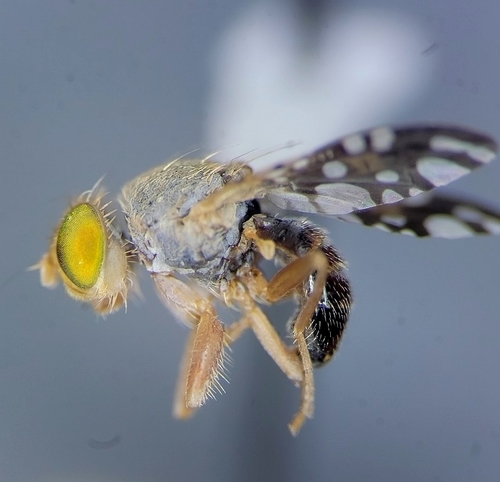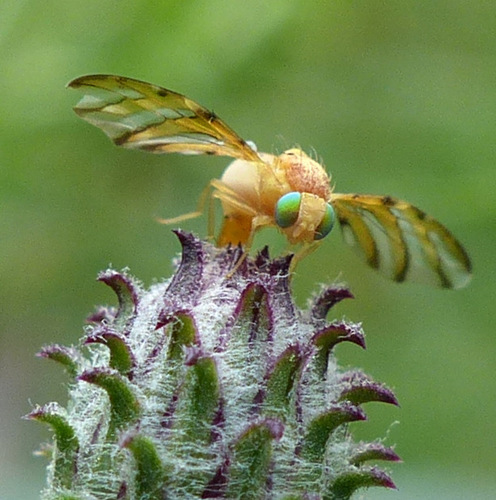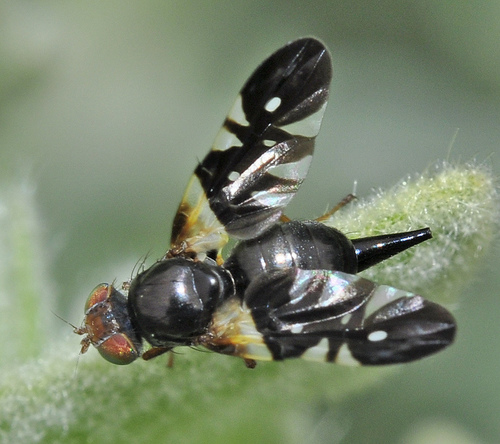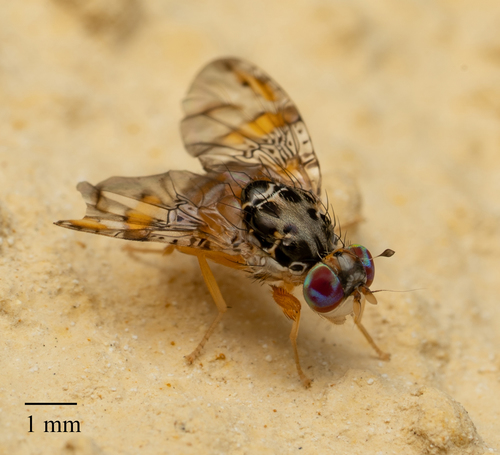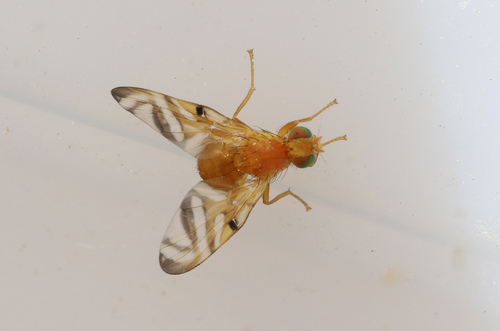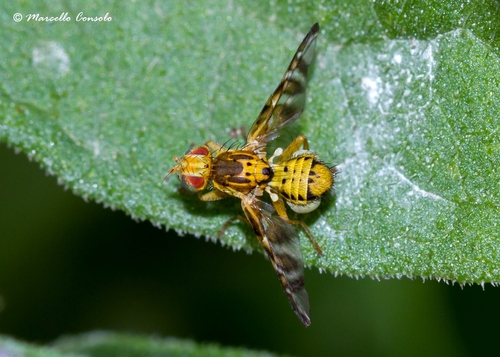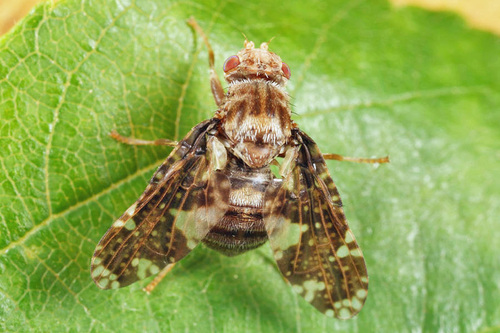
About Eurosta solidaginis (Fitch, 1855)
Eurosta solidaginis, commonly called the goldenrod gall fly or goldenrod ball gallmaker, is a species of fly native to North America. This species is best known for the characteristic galls it forms on multiple species of the Solidago genus, commonly called goldenrod. Adult female flies insert their eggs near goldenrod’s developing buds. After the eggs hatch, larvae migrate to the area below these developing buds, where they induce the plant’s tissues to form a hardened, bulbous chamber known as a gall. E. solidaginis has become a common focus of ecological and evolutionary biology research due to its well-documented interactions with its host plants and its insect and avian predators. Its natural tolerance to freezing temperatures has also prompted studies into the antifreeze biochemistry of this species. This species is widely distributed across the United States, ranging from Washington to the eastern seaboard. Its two recognized subspecies occupy distinct ranges. E. solidaginis subsp. solidaginis occurs from the east coast west to Minnesota and the Dakotas, north to the southeastern provinces of Canada, and south along the southern border of the United States. E. solidaginis subsp. fascipennis ranges from Washington in the west east to Minnesota. Adult E. solidaginis emerge from their galls in spring, with males emerging earlier than females. The flies mate on goldenrod plants, after which females use their ovipositors to insert fertilized eggs into goldenrod buds. While E. solidaginis has been recorded forming galls on seven different goldenrod species, only three are common common host targets: Solidago canadensis, S. gigantea and S. altissima. Larvae typically hatch 5 to 8 days after eggs are laid, then tunnel to the base of the goldenrod bud and induce gall formation. Galls act as both a food source for larvae and a shelter from rain, wind, and ice. Although the gall is the structure where larvae overwinter, it does not provide meaningful insulation. Instead, the larvae themselves have high natural freezing tolerance. Larvae feed on gall tissues and molt twice before excavating a narrow exit tunnel out of the gall in mid-September. After digging this tunnel without opening it to the outside, the larva overwinters inside the gall. If it survives, it will molt into an adult and exit the gall the following spring. Many predators and parasites feed on E. solidaginis larvae. Black-capped chickadees (Poecile atricapillus) and downy woodpeckers (Picoides pubescens) target large galls, breaking them open to remove and consume the larvae inside. Two species of parasitic wasp, Eurytoma obtusiventris and E. gigantea, also attack this gallmaker. E. obtusiventris injects its eggs directly into E. solidaginis larvae before gall formation, while E. gigantea deposits its eggs directly into the formed gall. In both cases, the E. solidaginis larva is consumed by the wasp larvae. The beetle Mordellistena unicolor also interacts with these galls: after hatching on the gall’s surface, beetle larvae burrow in and feed on the gall’s nutritive tissues. While M. unicolor usually kills the E. solidaginis larva in the gall, this killing is not a required part of the beetle’s life cycle. As a result of these diverse interactions, E. solidaginis larvae that produce moderate-sized galls have a clear fitness advantage. Moderate-sized galls are not small and thin enough for parasitic wasps to penetrate easily, and also not large enough to attract the attention of predatory birds. Beyond direct predation and parasitism, researchers have observed a negative correlation between E. solidaginis success and goldenrod defoliation by Trirhabda beetles. This suggests that competition for plant resources may also play an important role in the Eurosta-Solidago host system.