About Euroschinus falcatus Hook.fil.
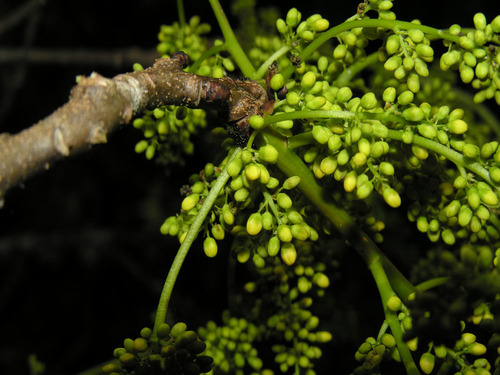
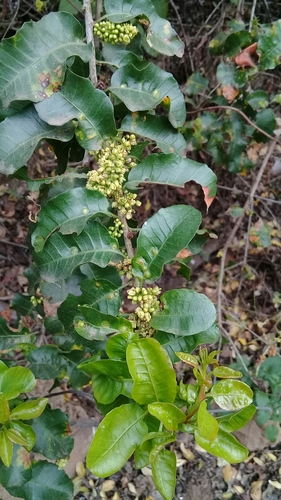
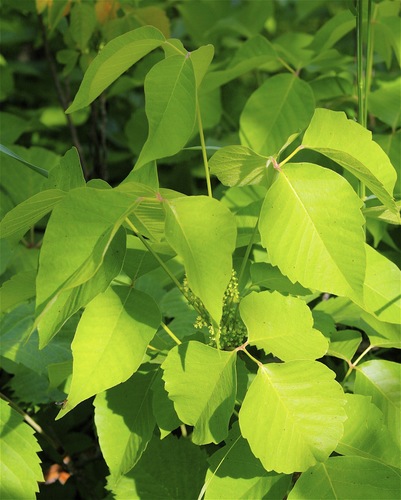
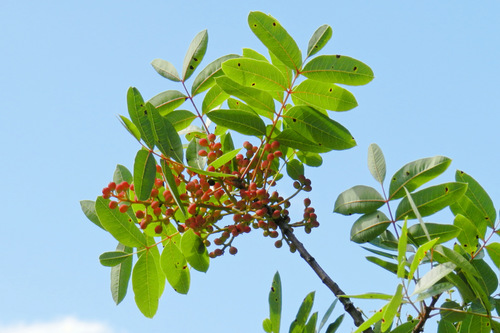
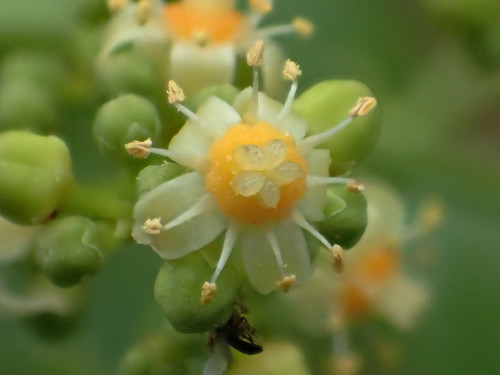
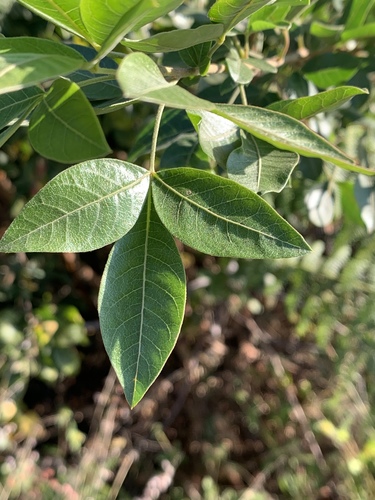
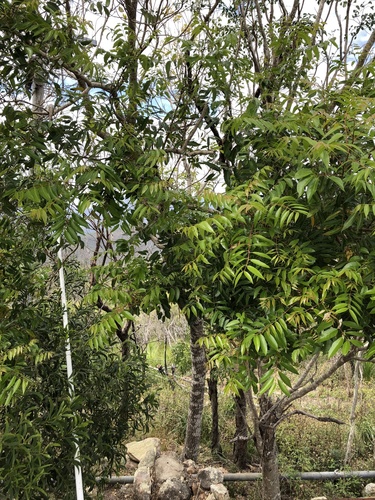
Euroschinus falcatus, scientific name Euroschinus falcatus Hook.fil., is a semi-deciduous tree that can grow up to 30 metres (98 feet) tall. Its bark is grey brown, with a texture ranging from wrinkly to tessellated. Larger specimens may develop buttress roots. Branchlets and twigs can be either finely hairy or completely hairless. This species has compound leaves that bear between four and ten sickle-shaped leaflets; each leaflet can reach up to 15 cm by 7 cm (5.9 inches by 2.8 inches). Leaflets have 6 to 11 pairs of lateral veins, and are arranged either oppositely or alternately along the leaf stem, with no true terminal leaflet. When leaves are crushed or twigs are broken, they release a clear sap that smells similar to mango. The plant produces conspicuous panicle inflorescences up to 18 cm (7.1 inches) long, covered in fine pale hairs. Its fragrant flowers are white, cream, or green, and grow on very short stalks called pedicels that are around 0.5 mm (0.02 inches) long. The calyx is green or yellow, with lobes reaching up to 1 mm (0.04 inches) long, while petals measure around 3 mm (0.12 inches) long. The fruit is a single-seeded drupe, which is ellipsoidal or ovoid in shape and around 8 mm (0.31 inches) long. Fruits are green when unripe, turning blue-purple or black when fully ripe. Common name blush cudgerie, this species is endemic to the east coast of Australia. Its natural distribution ranges from the Pascoe River near the northern tip of Cape York Peninsula south to the Shoalhaven River in southeastern New South Wales. It grows in tropical and sub-tropical rainforests, including beach forest and riparian forest, and is likely most common in monsoon forest. It can also be found in woodlands and on the margins of sclerophyll forest. It occurs at altitudes from sea level up to around 1,000 metres (3,300 feet). In its ecosystem, the fruit of Euroschinus falcatus is eaten by a range of bird species, including Lewin's honeyeater (Meliphaga lewinii), rose-crowned fruit dove (Ptilinopus regina), topknot pigeon (Lopholaimus antarcticus), crimson rosella (Platycercus elegans), green catbird (Ailuroedus crassirostris), silvereye (Zosterops lateralis) and paradise riflebird (Ptiloris paradiseus). Its leaves are eaten by Lumholtz's tree-kangaroo (Dendrolagus lumholtzi).