About Eurema hecabe (Linnaeus, 1758)
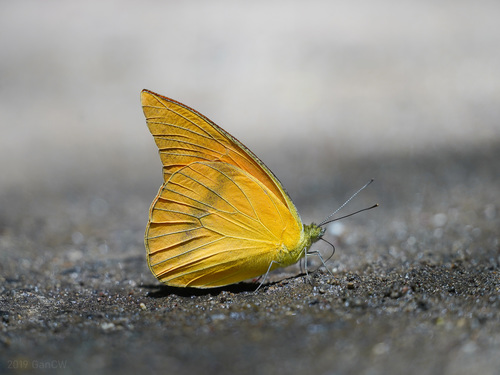
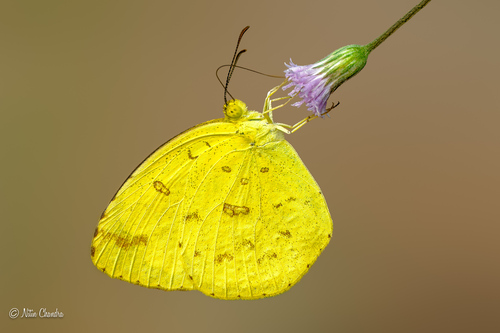
Eurema hecabe (Linnaeus, 1758), commonly called the common grass yellow, shows seasonal polyphenism. This lepidopteran has a darker summer morph, which is triggered by day lengths longer than 13 hours. When day lengths are 12 hours or shorter during the post-monsoon period, a lighter-colored morph develops. Females lay their eggs on host plants including Abrus precatorius, Falcataria moluccana, Acacia species, Aeschynomene species, and many other species from the plant families Leguminosae, Euphorbiaceae and Cucurbitaceae. Research indicates that females can distinguish between different colors when selecting host plants to lay their eggs. The larva of the common grass yellow is described as long, green, rough, cylindrical or slightly depressed, with a large head. The pupa is suspended by its tail and a moderately long band. Its abdominal segments are round, but the thorax is far more compressed, and the wing cases join to form a deep, sharp keel. The head case ends in a short, pointed snout. Most often, pupae are solitary and green, but they can sometimes occur in large numbers on twigs. Many larvae of Pierine butterflies and other groups congregate during this life stage. When the larvae choose a dead branch from a nearby bush for pupation, the resulting pupae take on the color of their surrounding habitat, a trait seen to varying degrees in almost all Pierine and Papilionine pupae. This species is known to be parasitized by multiple strains of the bacterium Wolbachia, and these bacteria can change the sex ratio of Eurema hecabe populations.