About Eurema blanda (Boisduval, 1836)
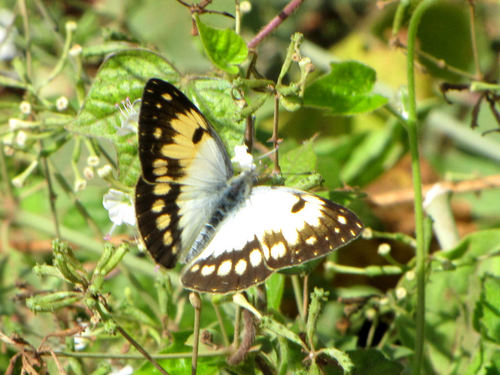
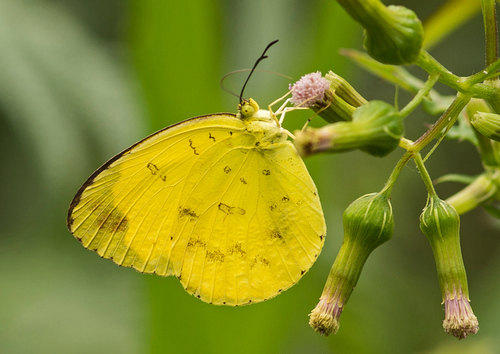
This description covers different seasonal forms of the butterfly Eurema blanda, originally described by Boisduval in 1836. Wet form: Males of the wet form have lemon-yellow upper wing surfaces. On the forewing, the outer marginal black band is broader at the anterior than it is in Sri Lankan specimens of Eurema hecabe; the posterior end of the band is shorter, and its inner edge slopes outward. The hindwing has a moderately broad black outer band. On the underside of the wings, both wings have more or less defined standard markings typical of the wet form. The forewing has three marks in the cell, in addition to the discocellular mark, and no sub-apical patch. Females of the wet form have not been observed. Intermediate form: Males of the intermediate form have not been observed. Females of the intermediate form have an outer forewing band that is similar to that of the wet form on the upper side. The hindwing has a broad black outer marginal band. The underside has slightly defined standard brown markings matching those of the wet form, and the forewing has a brown sub-apical patch. Dry form: Individuals of the dry form are smaller than those of the wet form. For dry form males, the outer marginal band on the forewing upper side is narrower, and its posterior end is much smaller. The hindwing has a slender outer band. On the underside, both wings have standard markings similar to those of the wet form, and the forewing has a more or less defined sub-apical patch. For dry form females, the black outer band on the forewing upper side is broader than it is in dry form males, and the outer band on the hindwing is also much broader than in males. The underside of both wings matches that of dry form males. Extreme Dry form: Males of the extreme dry form have not been observed. For extreme dry form females, the forewing upper side has a broad black outer band, whose posterior portion angles outward obliquely from the lower median veinlet. The hindwing has a moderately broad outer band. On the underside, both wings have standard markings matching those of the dry form, and the forewing has a prominent, almost complete quadrate apical brown patch. Recorded food plants for Eurema blanda are Caesalpinia mimosoides and Bauhinia purpurea.