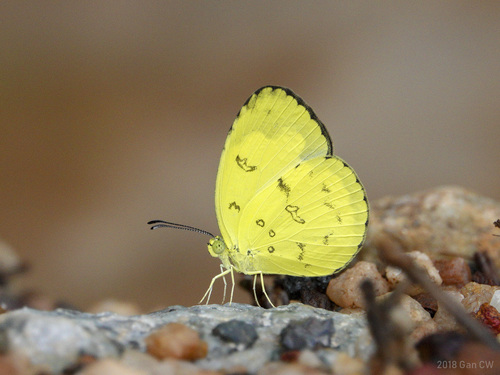
About Eurema andersoni (Moore, 1886)
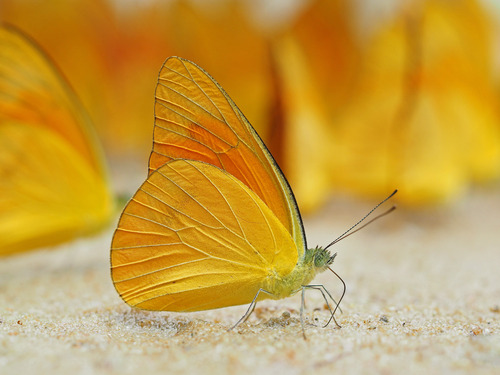
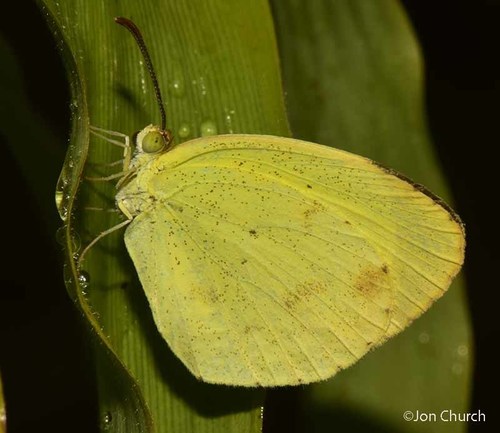
Scientific name: Eurema andersoni (Moore, 1886). Description of the wet form: The male has the following characteristics. On the upper side, the outer marginal band of the fore-wing is moderately broad; its medial portion is inclined slightly inward, and its lower portion is inclined very slightly obliquely outward. The hind-wing has a moderately broad outer band. On the underside, ordinary markings are only slightly defined. The fore-wing has two cell-marks, with the basal cell-mark being obsolescent. The female of the wet form has not been observed. Description of the dry form (fig. 2a, b): The male is similar to the wet form male on the upper side. On the underside, ordinary markings are distinct. The fore-wing has a medial cell mark, plus a more or less well-defined sub-apical patch. For the female of the dry form, the upper side is paler. The outer band of the fore-wing is slightly broader, and the outer band of the hind-wing is moderately broad. The underside matches that of the dry form male. Subspecies and distribution: Recognized subspecies and their ranges are as follows: E. a. andersoni (Moore, 1886) found in Peninsular Malaya, Langkawi, Singapore, Sumatra, Borneo, Thailand and Indo-China; E. a. godana (Fruhstorfer, 1910) found in Taiwan; E. a. udana (Fruhstorfer, 1910) found in West Java; E. a. ormistoni (Watkins, 1925) found in South India; E. a. anamba (Corbet & Pendlebury, 1932) found in Anambas; E. a. evansi (Corbet & Pendlebury, 1932) found in Andaman; E. a. jordani (Corbet & Pendlebury, 1932) found in Sikkim and Bhutan; E. a. konoyi (Morishita, 1973) found in Palawan; E. a. nishiyamai (Shirôzu & Yata, 1981) found in Nias Island; E. a. kashiwaii (Shirôzu & Yata, 1981) found in Sumba Island; E. a. sadanobui (Shirôzu & Yata, 1982) found in Thailand, Laos, Cambodia, southern Vietnam, and southern Yunnan; E. a. albida (Shirôzu & Yata, 1982) found in Borneo (Sarawak); E. a. shimai (Yata & Gaonkar, 1999) found in southern India. Life cycle: Larvae of this species have been recorded feeding on Ventilago goughii.