About Euptilotis neoxenus (Gould, 1838)
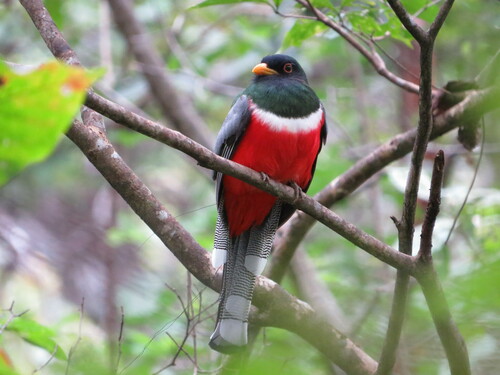
This species, Euptilotis neoxenus, has a body length of 33–36 cm (13–14 in). Both sexes have iridescent green backs, iridescent dark blue central tail feathers, and outer tail feathers that are mostly white at the tip with a black band at the base; females sometimes have partially black-and-white barred outer tail feathers. The bill is dull gray with a slightly darker band at the tip. Adult males have a blackish head, iridescent green breast, and geranium red belly and undertail coverts. Adult females have a gray head, breast, and upper belly, with less extensive bright red on the lower belly. Both sexes have wispy, hair-like auricular plumes that give the species its name, although these are rarely visible in the field. Compared to typical trogons, both the head and bill are rather small and narrow. The male's song, a tremolo call, is a series of whistled notes that increase in volume. Other calls include low-intensity squeals that rise in pitch, a loud squeal that ends with a sharp "chuck", and a strident cackle that is most often given in flight. Quetzals differ from typical New World trogons in several traits: they have iridescent wing coverts, less extensive fusion between the two forward-facing toes of their heterodactyl foot, broad tails with distinctly convex sides (rather than straight or concave sides), and pale blue egg shells. They also average larger in body size than typical trogons, and their eggs and young develop more slowly. The eared quetzal is considered a seemingly primitive form, and does not have the impressively long iridescent upper tail and wing coverts seen in members of the genus Pharomachrus, which includes the resplendent quetzal. Euptilotis neoxenus is a resident species that lives in the middle to upper levels of pine-oak woodlands and oak-conifer forests, and is often found along streams. Eared quetzals feed on insects, small vertebrates, and fruit, including the warty red fruits of madrone trees. Caterpillars, moths, katydids, cicadas, small lizards, and other similar prey are fed to the species' young. Like other trogons, eared quetzals often pluck prey and fruit while hovering. Members of this species have been observed to show aversion to large areas of conspicuous color on and near human observers, known as negative chromotropic responses, to the colors white, red, orange, and blue. This indicates that the species-confidence hypothesis, which states birds tend to be attracted to colors that match those found on their own species and repelled by colors not found on their species, does not apply to eared quetzals.