About Euprymna tasmanica (Pfeffer, 1884)
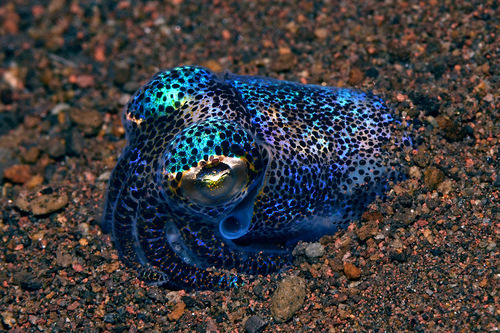
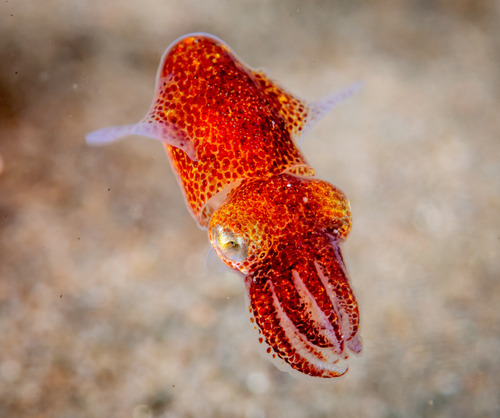
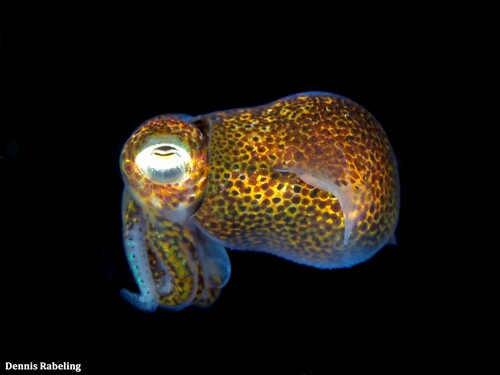
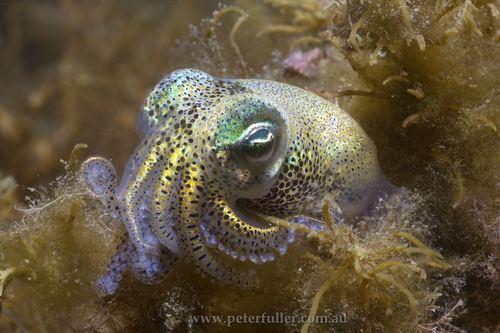
Euprymna tasmanica, commonly called the southern dumpling squid or southern bobtail squid, is a species of bobtail squid native to the shallow temperate coastal waters of southern Australia’s continental shelf, found at depths from 0.5 m to at least 80 m. Its natural range extends along the Australian coast from Brisbane on the east coast to Shark Bay on the west coast, and it also occurs around Tasmania, where it inhabits seagrass beds or areas with soft silty or muddy seabeds. This squid has a lifespan of between 5 and 8 months. Adults reach a total length of 6 to 7 cm, with a mantle length of 3 to 4 cm. The southern dumpling squid is nocturnal. During the day, it hides in sand or mud, covered by a mucus-lined coating of sediment. If disturbed, its acid glans can quickly shed this coating, acting as an extra decoy in addition to the squid’s ink squirting. Like many other cephalopods, male southern dumpling squid can be distinguished from females by an enlarged hectocotylus, which is modified from the first left arm. Towards the end of their lifespan, females lay 2 to 3 batches of round, creamy orange eggs over a few weeks, with each batch containing 25 to 170 eggs. Females die between one week and a fortnight after laying eggs, while males die a short time after mating multiple times. Females mate with many partners, and may use sperm from more than one partner to fertilize a single batch of eggs. Incubation time depends on water temperature, and can take up to four and a half months. This long incubation period requires eggs to be comparatively large to hold enough yolk for successful embryonic development. If females do not get enough food while producing eggs, they tend to produce fewer and smaller eggs, which results in high embryo mortality rates. Adult southern dumpling squid do not care for their young after laying eggs. When they hatch, the squid hatchlings are already highly developed, and are capable of catching prey up to twice their own size. Hatchlings are not born with the symbiotic bacteria required for their light organ to function, and must capture these bacteria from the surrounding water before the light organ can develop.