About Euprymna berryi Sasaki, 1929
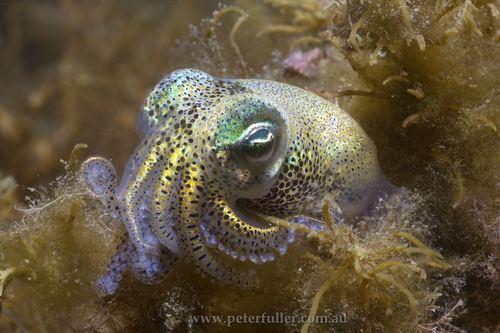
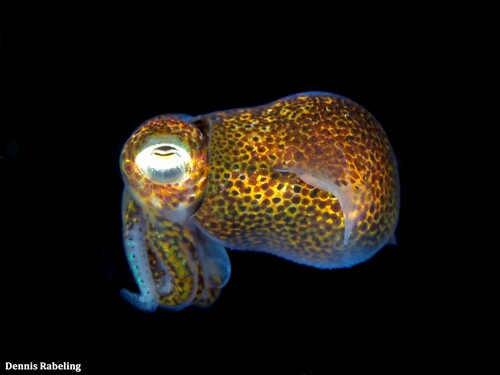
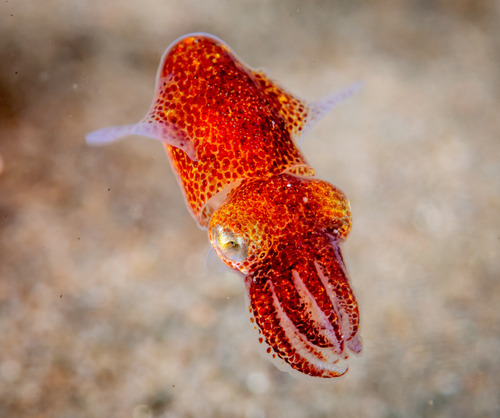
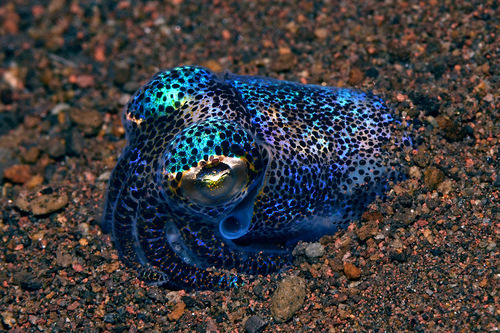
The hummingbird bobtail squid, scientifically named Euprymna berryi Sasaki, 1929, is a small species of bobtail squid. Adult size differs by sex: males grow no larger than 3 centimetres (1.2 in) in length, while females reach up to 5 centimetres (2.0 in) long. The squid has an overall compact and rounded body shape, with eight arms, two tentacles, and a pair of small lateral fins located on the posterior part of the mantle. Its body has a translucent background color, covered in a large number of tiny dark chromatophores. These chromatophores are spread across almost the entire body, including the arms, head, and both the ventral and dorsal regions of the mantle. The only areas that do not have full chromatophore coverage are the tentacles and the lateral fins; chromatophores only appear on the part of the fins that borders the mantle. To the eye, the squid's external color looks like a mixture of small dark, electric blue and green dots. This species is widespread in tropical waters of the central Indo-Pacific, ranging from Indonesia to the Philippines. There is evidence that its distribution may extend further to the Andaman Islands, Sri Lanka, and the western coast of India, where scientists collected specimens in 2006 or 2007. Euprymna berryi is a benthic species that lives on the seafloor. It prefers seafloors covered with sandy or fine sediment, as these substrates let it easily bury itself to rest during the day or hide when threatened.