About Eupolyphaga sinensis (Walker, 1868)
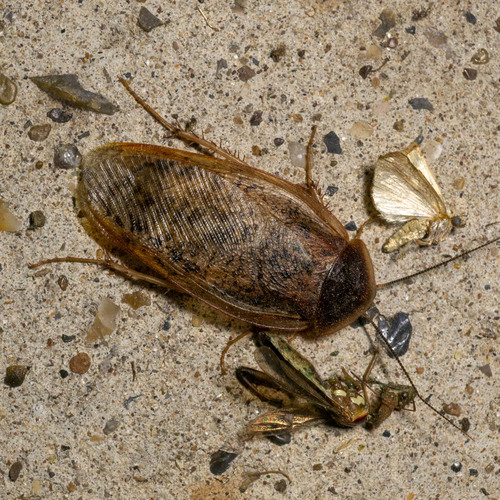
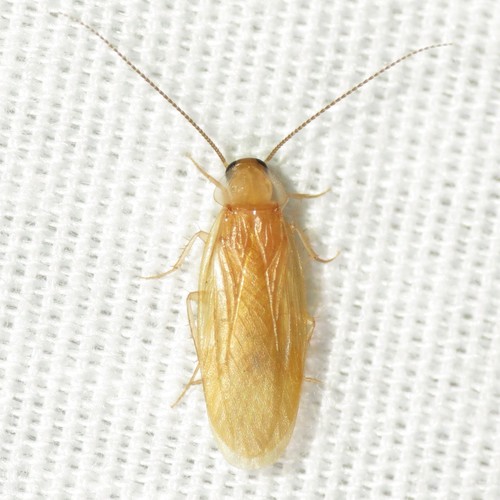
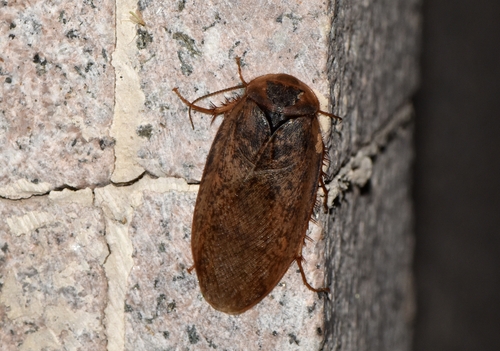
Eupolyphaga sinensis is a sexually dimorphic cockroach species. While it is often called a wingless cockroach, this description is incomplete: females are wingless, while males have wings. Females are typically larger and darker in color than males. Across the species' range, E. sinensis shows notable body size differences linked to temperature and latitude. Both male and female individuals grow larger at high and low latitudes, while those from intermediate latitudes are smaller. This size variation comes from genetic differentiation between populations adapted to their local climates. E. sinensis lives in a broad range of climatic conditions, from subtropical to temperate regions. Females and nymphs are most often found in woody substrate or under rocks. The species is mainly nocturnal, and hides in dark locations during the day, including under rocks, inside dead wood and bark, and in porous soil. E. sinensis is active at temperatures between 15°C and approximately 34°C, and reaches peak activity in late summer and early autumn. For reproduction and development, E. sinensis lays its eggs inside a protective ootheca, which the female carries at the end of her abdomen for varying periods of time. When the eggs are ready, the female either deposits the ootheca on the ground or attaches it to an object. The hardened ootheca shields the developing eggs. Temperature range and fluctuation patterns affect egg hatching success. Research shows the highest hatch rates occur when temperature alternates between 5°C and 30°C, with ootheca held at the lower temperature for seven days before staying at the higher temperature for the rest of development. Under this regime, average development time is 44 days. Less effective temperature combinations, such as alternating 10°C and 25°C, produce longer average development times of 61 days. E. sinensis has a flexible life cycle, which can last between 1 and 3 years depending on the latitude of the population. Females can live up to 30 months, while males have much shorter lifespans. Variable lifespans correspond to varying numbers of immature instar stages, which can be 7 to 9 or 9 to 11. Males generally develop faster than females, and all individuals develop more slowly at lower temperatures. Due to growing interest in E. sinensis across multiple fields, large-scale breeding operations have been established across China. In traditional Chinese medicine, E. sinensis (called Tubiechong) has historically been used to treat a range of ailments, including bruises, fractures, amenorrhea, and postpartum blood stasis, and it has also been used as a pain reliever. Tubiechong can be prepared through different methods depending on the condition being treated, including grinding, frying, water extraction, and rice wine extraction. The most common preparation methods are water and rice wine extraction. Only female individuals are used for medicinal purposes. Traditional Chinese medicine practitioners claim that Tubiechong can reduce and treat tumors through its effects on blood vessels, and this effect on blood vessels is the reason it has been and continues to be prescribed for the conditions it treats. In Western medicine, there has been a recent increase in research to confirm the efficacy of the claimed benefits of E. sinensis, and to identify additional potential medical uses. Tests on immunosuppressed mice have shown positive effects on immune system function, which indicates an area for future research into human applications. Chitosan from E. sinensis can be extracted for use in manufacturing nanofiber membranes for wound dressings, a research area that has grown in recent years. Chitosan from shrimp and crab is most commonly used for this purpose, and extracting chitosan from E. sinensis aims to address seasonal and regional supply restrictions. E. sinensis has a high protein content, so it is used as food in some regions of China and considered a delicacy by some people. Traditionally, only adult females have been used for both medicine and food, because of the belief that females have higher nutritional quality than males. Recent research has found that nutritional composition varies by sex and life stage. When comparing males and females directly, neither is inherently superior; their compositions differ, but both are valuable. The average protein content of E. sinensis is recorded at 57.25 ± 6.12%, which is higher than most other edible insects, milk, and eggs, though it is not as high as pork and beef. Nymphs have significantly lower protein content than adults. Fat content ranges from 15.70 ± 0.78% to 18.89 ± 0.31%, which is comparable to pork and species in the order Orthoptera, but lower than other species within the order Blattodea. E. sinensis is also a good source of essential minerals and amino acids. It is commonly described as having a strong fishy odor and a salty taste.