About Euploea mulciber (Cramer, 1777)
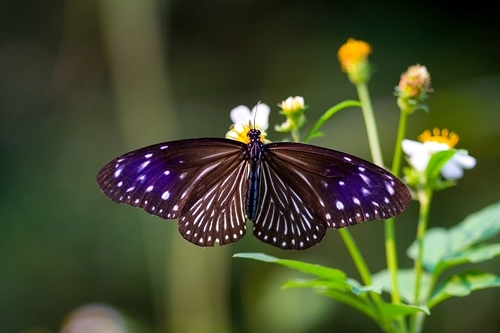
Euploea mulciber (Cramer, 1777) has an ovate hindwing. For the upperside: Males are entirely dark brown, glossed with brilliant blue, and have violescent white spots: one spot at the apex of the cell, a strongly curved series of five or six discal spots, a sinuous subterminal row of larger spots, and an incomplete terminal series of dots. The male hindwing is uniform and unmarked except for a large patch of light-brown, densely packed hair-like scales on the outer upper third of the wing. Females are a lighter brown, and only the forewing disc is glossed with blue. Their spots are white, more or less similar to the spots on the male forewing, but larger and pure white; in addition, a streak in the cell and another curved streak in interspace 1 show faintly through from the underside. On the female hindwing, there are narrow white streaks in the cell and in the interspaces beyond, plus a terminal row of slightly elongate white spots. The underside is similar to the upperside for both sexes, but all markings are broader, larger, and more distinct. In addition to these, males have a small white spot at the apex of the cell, two or three discal white dots, and incomplete subterminal and terminal series of white dots. The antennae, head, thorax, and abdomen are dark velvety brown. The abdomen is glossed with greenish blue on its upper surface. On the underside, the head and thorax are spotted, and the abdomen is marked with transverse white bands. The larva is cylindrical, with four pairs of long fleshy subdorsal filaments that have pink bases and black tips. Three pairs of these filaments are on the anterior segments, and the fourth pair is on the 12th segment. The body is pinkish white with lateral yellowish blotches. Each segment is divided by a black line, and is bordered anteriorly by a narrow transverse pink band and purple-brown stripes. Spiracles are black. The head has a dark red stripe on the front and one on each side. The fore legs are black, while the middle and hind legs are black ringed with pink. This description comes from Moore, for the Javan form originally named E. claudia. The pupa is short, thick across the middle; the thorax is concave behind; abdominal segments are convex dorsally, and it is metallic golden-brown with a darker brown anterior stripe, as described by Moore. Larvae feed on Nerium indicum, N. oleander, Ichnocarpus spp., Toxocarpus wightianus, Aristolochia spp., Argyreia penangiana, Ficus spp., Ficus retusa, F. benjamina, and Ichnocarpus volubis.