About Euplectes progne (Boddaert, 1783)
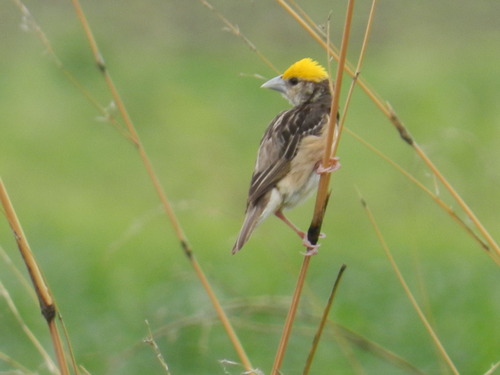
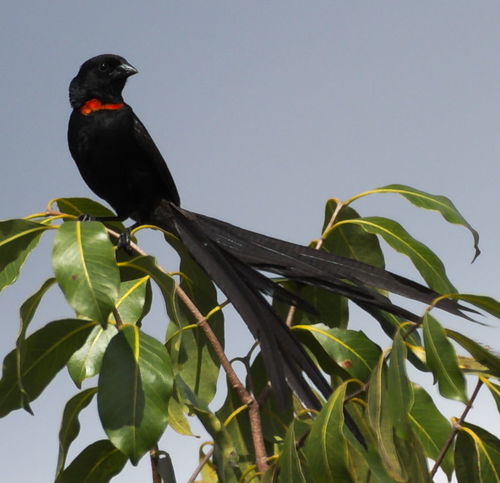
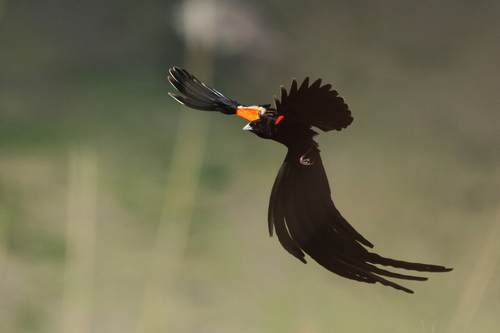
Long-tailed widowbirds (Euplectes progne) show clear sexual dimorphism, with differences in both behavior and physical traits between males and females. Adult breeding males are entirely black, including under their wing-coverts. Their wing shoulders are orange-red, their wing-coverts are white, and their bills are bluish-white. They are best known for their distinctively long tails, which have 12 tail feathers total. Six to eight of these 12 feathers are roughly half a metre (around 20 inches) long. Male wingspans measure approximately 127 to 147 mm (about 5 to 5.8 inches). Females have more muted, subdued coloration. The upper part of a female’s body is streaked with buff, tawny, and black. A female’s chest, breast, and flanks are slightly paler than her upper body. The area under her wing-coverts is black, her tail feathers are narrow and pointed, and her bill is horn-colored. Non-breeding males are slightly larger than females, and look very similar to them. For the most part, non-breeding males share the same coloration as females, the only difference being that they have broader streaks both above and below, and retain the wing and wing shoulder structure of breeding males. Rarely, non-breeding males have elongated brownish-black tail feathers, but these are still much shorter than the tail feathers of breeding males. Immature males and females look very similar to adult females. However, like adult non-breeding males, immature males are slightly larger than adult females. Females start at 15 cm in total length, while males have been recorded at up to 71 cm when including their tail. Males weigh between 33 and 46 g, and females weigh between 25 and 39 g. There are three known isolated populations of long-tailed widowbirds. The first is located in the Kenyan highlands, the second in Angola, southern Zaire, and Zambia, and the third in southern Africa. It is unknown when these populations were last in contact with one another, and the central population has the greatest morphological differences compared to the other two. The southern African population stretches from the Eastern Cape (Transkei region) through the Free State, Lesotho, KwaZulu-Natal, and western Eswatini to the Transvaal plateau. The species only enters southeastern Botswana, and is most common in the central highveld of South Africa. Long-tailed widowbirds typically live in swampy grassland, in flocks made up of one or two males and multiple females. Males fly with their tails drooping and partially spread, moving their wings in slow, regular motions. In wet weather, their elongated tails prevent them from being able to fly. During the non-breeding season, long-tailed widowbirds gather into larger flocks that roost in reed beds. In the Drakensberg Mountains, this species can be found at elevations up to 2,750 metres (9,022 feet). The long-tailed widowbird’s diet is mostly made up of seeds, with arthropods added occasionally. These birds do most of their foraging in flocks on the ground, though they are sometimes seen catching insects in the air. They feed on a wide range of specific seeds, including seeds of Setaria sphacelata (twisted-leaf bristle grass), Paspalum dilatatum (common paspalum), Paspalum distichum (couch paspalum), Pennisetum clandestinum (Kikuyu grass), Triticum (wheat), Themeda triandra (rooigras), and Senecio juniperinus (groundsel). They also eat insects, including beetles (Coleoptera), cicadas and aphids (Hemiptera), as well as spiders.