About Euplectes orix (Linnaeus, 1758)
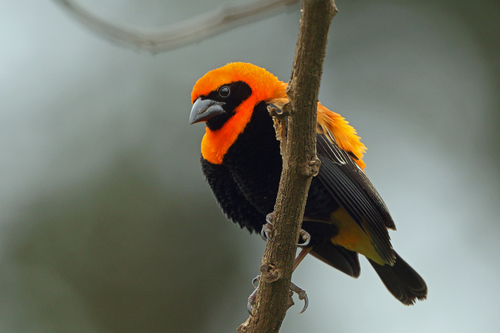
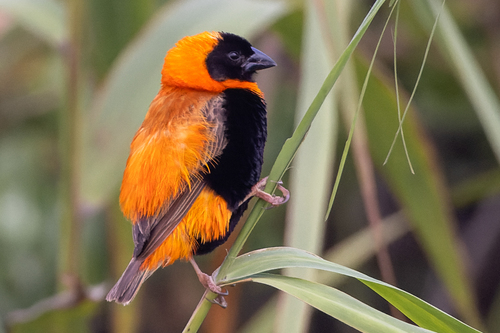
The southern red bishop, scientifically named Euplectes orix (Linnaeus, 1758), measures 10–11 centimetres in length and has a thick conical bill. Breeding males have bright red (occasionally orange) and black plumage: their forehead, face, and throat are black, the rest of the head is red, the upperparts are red except for the brown wings and tail, the upper breast and under tail-coverts are red, and the lower breast and belly are black. Non-breeding males and females have streaky brown plumage that is paler on the underside, and females are smaller than males. This species produces a range of twittering calls and a nasal contact call; breeding males have a distinctive buzzing song. Compared to the southern red bishop, breeding males of the northern red bishop have a red throat, black plumage that extends further back on the crown, and long tail-coverts that almost completely cover the tail. Female and non-breeding northern red bishops are almost identical to southern red bishops of the same age and sex. The southern red bishop is distributed from South Africa northward to Angola, the southern and eastern parts of the Democratic Republic of Congo, northern Zambia, southern Uganda, north-east Nigeria, and south-west Kenya. It is mostly absent from the Namib Desert and the Kalahari. During the breeding season, it inhabits areas near water, found among grass, reeds, sedges, or crops such as sugar cane. Outside of the breeding season, it moves into drier grassland and savanna habitats.