About Euplectes franciscanus (Isert, 1789)
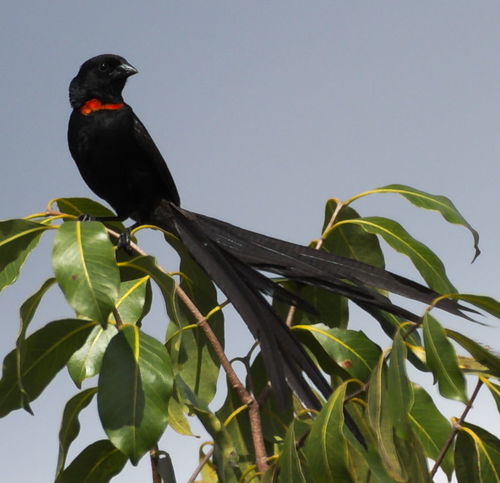
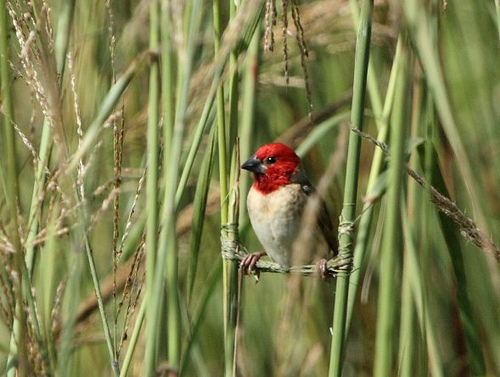
This species, the northern red bishop (Euplectes franciscanus), is a small short-tailed bird, measuring about 11 cm in length and weighing approximately 12 to 22 grams. The striking red-orange plumage of breeding males is created by carotenoid pigments obtained from dietary compounds; lutein and two red fractions (R1 and R2) derived from lutein are the dominant carotenoids that produce this pigment in wild individuals, and captive northern red bishops lack the R2 red fraction in their diet. The colorful plumage covers the male's back, and wraps from the chin around to the back of the head, throat, and breast, while the crown, forehead, flank, and belly are dark black. The tail and upper wings are brown, the legs are pale, and the bill is black. This characteristic plumage, which identifies the northern red bishop, is only worn by breeding males. Females and non-breeding males have a soft brown and white feather pattern similar to that of a song sparrow. Males transition into this bright breeding plumage at the start of the breeding season, and molt these display feathers at the end of the breeding season to grow plumage similar to that of females. The northern red bishop has a wide native distribution across northern Africa, with recorded populations in northern Liberia, southern Mauritania, Senegambia, Guinea, northern Sierra Leone, eastern Eritrea, Ethiopia, northwestern and southern Somalia, northeastern Democratic Republic of the Congo, northern Uganda, Burkina Faso, northern Ivory Coast, southern Chad, northern Cameroon, Sudan, Tanzania, and Kenya. It typically inhabits tall grasslands or cultivated areas near water and marshes, and can be found from lowlands up to elevations of 1000 meters. The species was introduced to Puerto Rico in the 1960s, and has since been recorded across the West Indies, including in Martinique, Guadeloupe, Barbados, Jamaica, St. Croix (U.S. Virgin Islands), and Cuba. In recent decades, it has also been introduced to parts of the United States: southern California, Texas, and Hawaii. In 1997, the estimated population of northern red bishops in Los Angeles and Orange counties, California was 400 individuals; this population has likely declined in recent years due to loss of marshland habitat, and a small population also exists in Harris County, Texas. Northern red bishops feed mostly on grass seeds, but also eat insects. Specific grasses they feed on include Echinochloa, Cortaderia, and Paspalum dilatatum, and they favor millet seeds. They also feed on the aquatic vegetation Polygonum and cocklebur (Xanthium). In late winter and spring, they have been observed visiting seed feeders. They usually forage on the ground or within grass and weed stems, and can hunt insects both on the ground and in flight. During the nonbreeding season, northern red bishops typically form large flocks, and may associate with other canaries or waxbills.