About Euplectes afer (Gmelin, 1789)
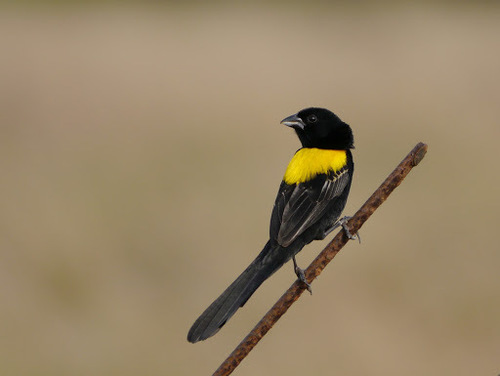
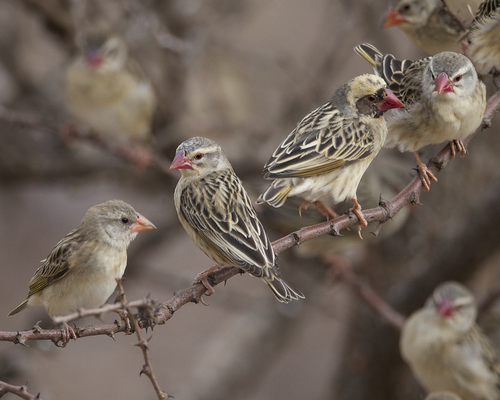
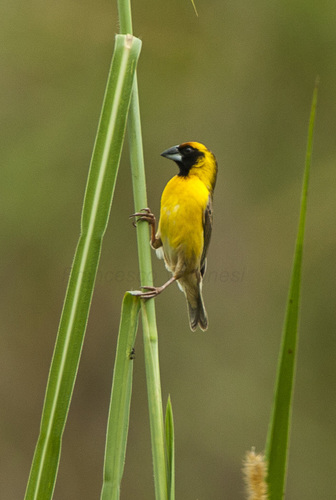
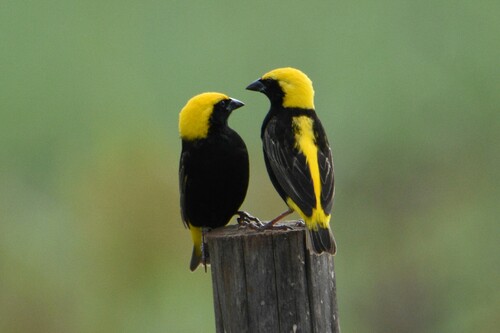
The yellow-crowned bishop, scientifically named Euplectes afer (Gmelin, 1789), measures 95 to 105 mm (3.7–4.1 in) in length and weighs 15 g (0.53 oz). This species is sexually dimorphic during breeding season, when distinct observable physical differences between males and females become apparent. Breeding-season males have distinctive golden yellow and black plumage. Both sexes have a short, conical bill. The male's bill is black during breeding season; during non-breeding season, the male's bill is horn-colored, matching the consistent horn color of the female's bill. All individuals have pinkish brown legs and feet. Breeding males have a black lower face, throat, breast and belly, along with a wide black collar on the back of the neck. They have a brilliant yellow crown, forehead, and hindcrown, a yellow shoulder patch, and yellow rump and back. Their wings and tail are brown. During non-breeding season, male plumage matches the appearance of female plumage. Female yellow-crowned bishops have pale brown upperparts marked with darker streaking. They have a paler eyebrow, off-white underparts, and fine dark streaks across the breast and flanks. Breeding-plumage male yellow-crowned bishops resemble yellow bishops, but yellow bishops are larger and do not have the yellow crown seen on yellow-crowned bishops. Non-breeding males and female yellow-crowned bishops can be confused with non-breeding individuals of the southern red bishop, but yellow-crowned bishops have white underparts, while southern red bishops have buff-coloured underparts. The yellow-crowned bishop is native to multiple African countries: Angola, Benin, Botswana, Burkina Faso, Cameroon, Central African Republic, Chad, Republic of the Congo, Democratic Republic of the Congo, Ivory Coast, Ethiopia, Gabon, Gambia, Ghana, Guinea, Guinea-Bissau, Kenya, Lesotho, Liberia, Mali, Mauritania, Mozambique, Namibia, Niger, Nigeria, Senegal, Sierra Leone, South Africa, Sudan, Tanzania, Togo, Uganda, Zambia, and Zimbabwe. It has been introduced to Jamaica, Japan, Puerto Rico, Portugal, Spain, and Venezuela. Escaped males that defended territories have been recorded in southern California, but it is not known if the species is still present in this area. The yellow-crowned bishop prefers habitats including grasslands, vleis, and pans. It is also commonly found in wheat and sorghum fields, and in weedy vegetation growing along wetlands.