About Eupithecia virgaureata Doubleday, 1861
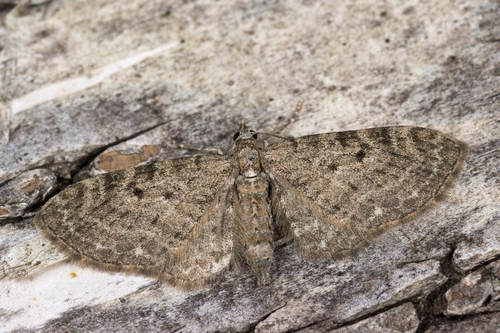
The goldenrod pug, scientific name Eupithecia virgaureata, is a moth belonging to the family Geometridae. This species was first described by Henry Doubleday in 1861. It can be found across the entire Palearctic region. In the British Isles, it is widespread but has a rather local distribution. The ground colour of the forewings ranges from pale grey-brownish to fuscous, and occasionally carries an ochreous tinge. Forewings are darker along the costa, marked with distinctive pale fascia and a whitish tornal spot. The forewing patterning is dominated by a conspicuous dark discal spot and smaller costal spots. The obtusely angulated dark grey striae are not defined anywhere except on the costa. A pale interrupted subterminal line is present, and melanic forms of this species are quite frequent. The wingspan of the goldenrod pug measures 17 to 20 mm. Mature larvae are slender with short brushes, light yellowish brown in colour with white slashes along the sides and a variety of bell-shaped brown spots on the back.