About Eupithecia pusillata (Denis & Schiffermüller), 1775
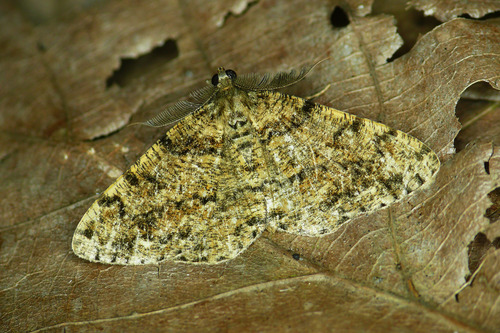
The juniper pug, also called the juniper looper (Eupithecia pusillata), is a moth species in the family Geometridae. It was first described by Michael Denis and Ignaz Schiffermüller in 1775. This species is found across the entire Palearctic region, ranging from Ireland to the Russian Far East, and also occurs in the Nearctic. The subspecies E. p. interruptofasciata is sometimes treated as a separate valid species called Eupithecia interruptofasciata.
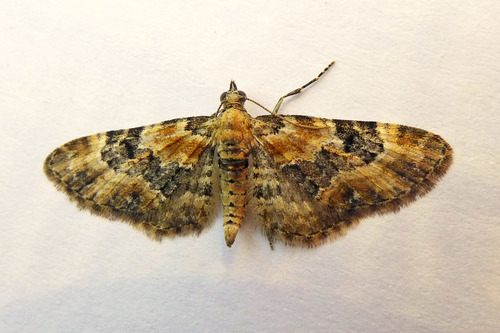
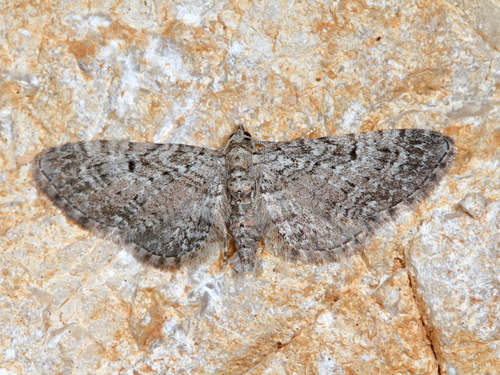
Eupithecia pusillata has forewings that are greyish brown, and often feature two distinctive black cross bands. The wingspan of this moth measures 17 to 21 millimetres (0.67 to 0.83 inches). The species is relatively contrastingly colored, with distinct light and dark cross-bands and short black longitudinal lines. It often lacks a black discal spot in the middle of the wing. While it is extremely variable in appearance, it can generally be recognized by its acutely angulated antemedian line, a whitish patch between the discal dot and the postmedian line, and dark dashes proximal to the postmedian line. The form graeseriata Ratzer (also called latoniata Mill.) is larger and greyer than the typical form, generally more weakly marked, and is found in the Swiss Alps, where it is also very variable. The form anglicata H-Sch. is found on the chalk cliffs of Kent, and is a whitish grey form with a rather characteristic appearance. The form scoriata Stgr. comes from Iceland, and is a dark, weakly-marked form.
The larvae of this species have a number of short brushes and numerous small white warts. Their body is green, with either a simple dark stripe along the back, or a pattern of varying bell-shaped dark brown spots along the back. Adult moths fly at night from July to September, and are attracted to light. In the Old World, larvae feed on Juniperus (juniper) and some other conifers in the cypress family, including Chamaecyparis and Thuja. In the New World, a wider range of food plants has been recorded; in addition to juniper, these include apple, clover, raspberry, redcurrant, strawberry, sunflower, and willow. This species overwinters in the egg stage.