About Eupithecia icterata (de Villiers, 1789)
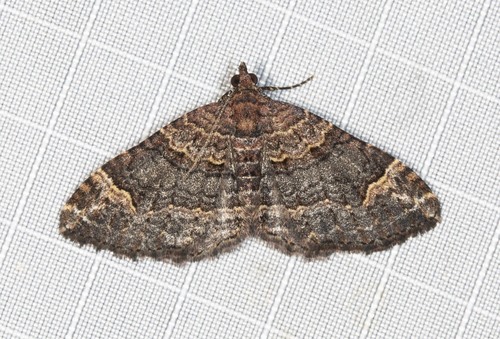
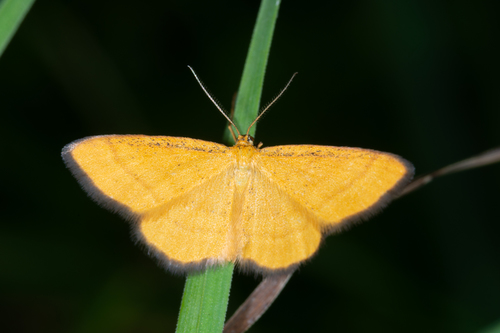
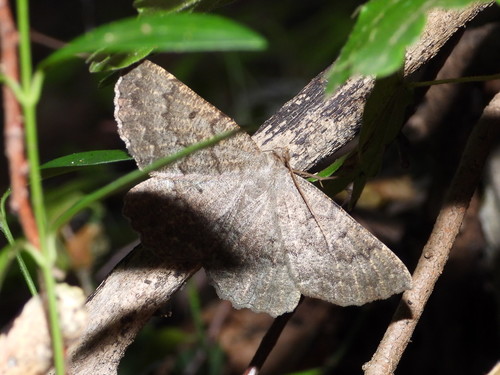
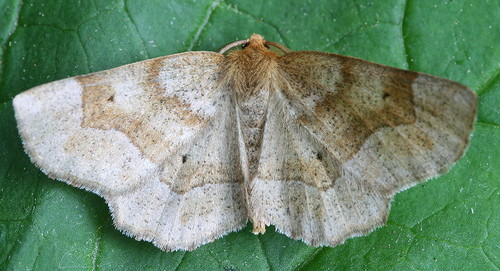
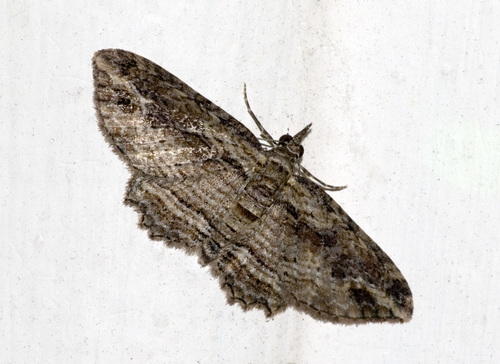
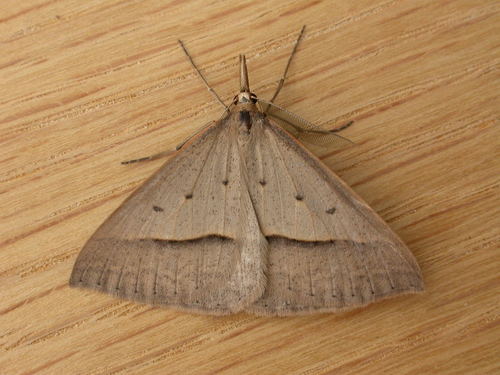
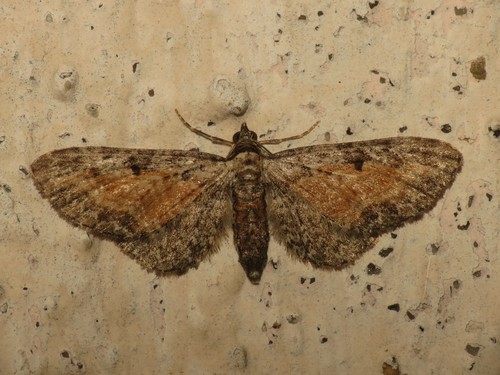
Eupithecia icterata, described by de Villiers in 1789, has a wingspan that reaches 20–24 mm, making it one of the larger species in its genus Eupithecia. Unlike many other pug moths, this species has distinctive markings, and occurs in two main color variants. In the form f. subfulvata, the forewings have a base color ranging from light gray to lead gray, with a large, clear two-toned tawny-orange triangular marking that extends upward from the rear edge of the wing, but does not reach the front edge. A distinct black spot is visible in the center of the forewing. The form f. cognata does not have this large tawny-orange marking. In this variant, any reddish area on the forewing is either more variegated, indistinctly marbled and mixed with gray tones, or is completely absent. Slightly prominent faint wavy lines with black outlines on a light background can be seen. For both color variants, the hindwings are grayish brown, slightly lighter in shade than the forewings, and have a small black central spot. Eupithecia icterata is generally similar to other species in the genus Eupithecia. In particular, Eupithecia icterata f. cognata is very similar to Eupithecia millefoliata, but Eupithecia millefoliata is usually paler in overall color and has a smaller central spot on its forewings. The species' egg is initially whitish, and develops yellowish tints as it matures. It has an oval shape, and its shell sculpture has depressions bordered by raised strips. Full-grown adult larvae are slender, with a base color ranging from purple-gray to brown. They have a dark diamond-shaped marking on their back, and a pale whitish longitudinal line running along each side. This species is distributed across the entire Palearctic region, the Near East, and North Africa. It is present across most of Europe, but is absent from Portugal, the northernmost part of Scandinavia, Iceland, and some Mediterranean islands. In the Sierra Nevada, it can be found at elevations as high as 3000 meters. In Asia, it occurs in Turkey, the Caucasus, Iran, Kazakhstan, and Western Siberia, extending east as far as the Altai Mountains. It also lives in the Atlas Mountains of North Africa. These moths prefer dry mountain meadows, forest edges, and parks. They can also be found in areas with their host plants along road edges, field edges, and near bush patches, as well as in semi-arid grasslands, scattered shrubbery, and perennial herb fields that have a warm microclimate.