About Euphydryas aurinia (Rottemburg, 1775)
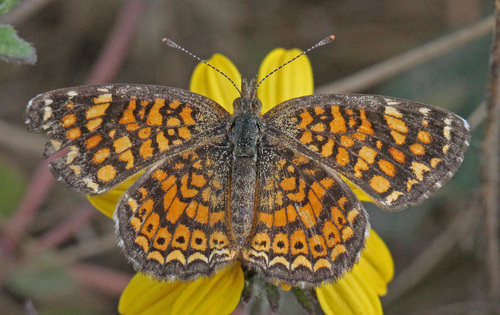
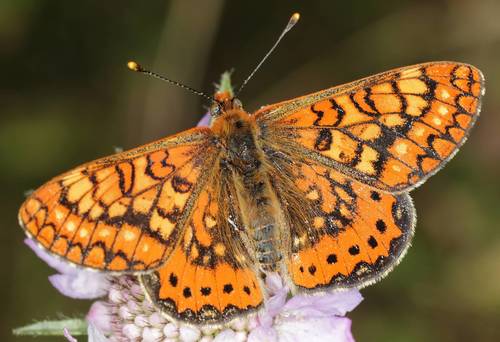
Euphydryas aurinia (Rottemburg, 1775), commonly known as the marsh fritillary, has sexual dimorphism in size: males have a wingspan of 30–42 millimetres (1.2–1.7 in), while females are usually larger, with a wingspan of 40–50 millimetres (1.6–2.0 in). This small butterfly species is highly variable in colouration and markings, with many recorded forms and subspecies. Adult individuals typically display a chequered pattern of brown, orange, and yellow markings, with silver markings along the edge of the hindwing. The underside of the wings is patterned with yellow, orange, and brown, and has no silver colouration at all. The species lays yellow eggs in large, easily identifiable batches, and mature larvae are solid black. This species is widespread across the Palearctic realm, ranging from Ireland in the west to Yakutia in the east, and extending south to north-west China and Mongolia. The marsh fritillary is in population decline across Europe, and is one of eleven butterfly species covered by the United Kingdom Biodiversity Action Plan. Within the British Isles, it occurs more frequently in the south and west, with Wales holding a particularly strong population stronghold. Its typical habitats include calcareous grassland, woodland clearings, damp marshy areas (the origin of its common name), and heathy grassland dominated by tussock-forming grasses such as purple moor and rush pastures. In Finland, E. aurinia prefers semi-permanent grasslands and young, rather than old, forest clearcuts, because old clearcuts develop overly dense vegetation that makes them less suitable. In the United Kingdom, it can inhabit two main grassland types: damp neutral or acidophilus grasslands, and dry calcicolous (lime-rich soil) grasslands with abundant calcicolous plants. This butterfly occurs at elevations ranging from 10–2,200 metres (33–7,218 ft) above sea level. In the British Isles, it is most often found in damp heathy grasslands called rhos pastures, from the Welsh word rhos meaning heath. Small populations of this species are ecologically important, as they produce many mobile individuals that can colonize new suitable sites to establish additional populations. The marsh fritillary is protected under UK law (listed on Schedule 5 of the Wildlife and Countryside Act) and under the EU Habitats and Species Directive (Annex II). The Devon Wildlife Trust owns and monitors multiple sites that host this species, including Stowford Moor near Holsworthy, Devon, Dunsdon nature reserve near Bude, Mambury Moor near Great Torrington, Vealand Farm nature reserve near Holsworthy, and Volehouse Nature Reserve near Holsworthy. In 2009, population counts at these sites were significantly higher than counts recorded in 2007 and 2008. In 2018, a breeding population was rediscovered in Carmarthenshire, Wales, after 50 years of local absence. In Lithuania, E. aurinia has been a protected insect species included in the Lithuanian Red Data Book since 2000, where it is categorized as red list category 3 (R). It typically occurs in natural and seminatural moist or wet oligotrophic grasslands (purple moorgrass and heath rush meadows) and base-rich fens, concentrated mostly in Eastern, North-Western, and Central Lithuania where its main larval foodplant Succisa pratensis (family Dipsacaceae) grows in abundance. Habitated patches are most often located along woodland edges or surrounded by bushes. The species is not found in Southern Lithuania, where sandy soils predominate, or in South-Western Lithuania, where intensive agriculture is widespread. In Croatia, the species has only been recorded historically from the north of the country. Modern attempts to confirm its current presence have failed, although northern Ivanščica and the Lobor valley are considered promising potential sites. The two most important factors for an optimal E. aurinia habitat are the availability of its larval food plant S. pratensis and appropriate grass height. As of 2017, Denmark has seen a rapid population decline of E. aurinia caused by loss of habitat and loss of host plants. Because the larval stage is entirely dependent on S. pratensis as a food source, reduced availability of this host plant directly harms E. aurinia populations. Declines in natural habitat suitable for S. pratensis directly correlate with declines in the host plant's population. Over recent years, the frequency of S. pratensis populations has dropped due to agricultural cultivation and shifts in land use away from traditional farming toward intensive grazing. S. pratensis grows most successfully on damp, basic soils. Environmental changes including acidification and eutrophication have reduced the amount of optimal habitat available for S. pratensis, and consequently for E. aurinia. As of 2019, the butterfly has become regionally extinct across most of its former range in the United Kingdom. The UK population size has decreased by 60% since systematic recording began. Human activities such as modern farming have altered the species' main habitat, England's damp meadows, and also contributed to climate change. This major habitat loss has caused fragmentation and isolation of E. aurinia populations, leading to the formation of metapopulations. E. aurinia is more vulnerable to extinction in the small subpopulations that make up a metapopulation. According to the 2019 report from the Joint Nature Conservation Committee, E. aurinia populations have "declined dramatically in Europe and is regarded as endangered or vulnerable in most of its European range," with remaining populations in the UK and Spain considered the "European strongholds" for the species. Euphydryas aurinia is a univoltine species, meaning it produces one generation per year.