About Euphrasia stricta J.P.Wolff ex J.F.Lehm.
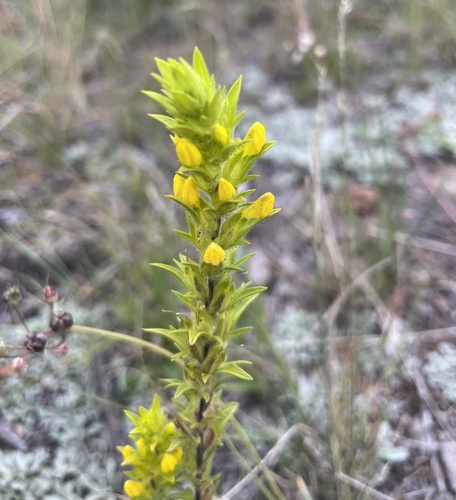
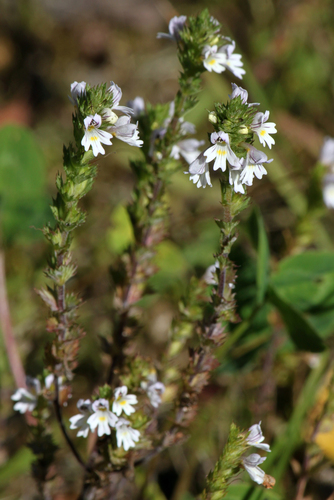
Euphrasia stricta, commonly known as drug eyebright, is an annual forb belonging to the genus Euphrasia. It is native to Central Europe and the Pyrenees, and has been introduced into northeastern North America. In this introduced range, it can be found in all of New England except Connecticut, as well as in New York, Pennsylvania, the upper peninsula of Michigan, northern Wisconsin, Minnesota, Illinois, Nova Scotia, New Brunswick, Prince Edward Island, Ontario, and Quebec. This species prefers to grow on moist, calcareous sands, such as the substrates found in some moors and dunes. Euphrasia stricta is a hemiparasite, meaning it is able to steal water and salts from host grasses. It has a history of use in herbal medicine for the treatment of inflammatory eye conditions, most commonly allergic conjunctivitis. However, Germany's Commission E has concluded that there is not sufficient evidence to confirm that eyebright is effective for any medical condition. No human clinical trials have been conducted to support the traditional medicinal claims about this plant, though the lack of available evidence does not confirm that the plant is ineffective.