About Euphrasia cuneata G.Forst.
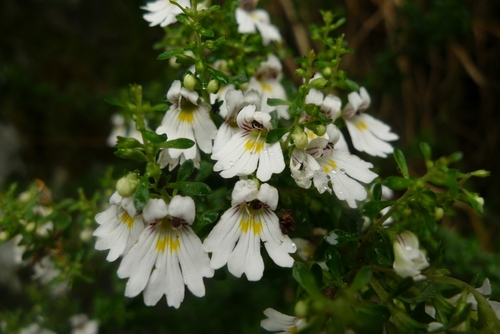
Euphrasia cuneata G.Forst. is a perennial herb or shrub-like plant that grows up to 60 cm (24 in) tall. This species shows natural variation in leaf shape, flower size, and flower colour. Stems range from simple to heavily branched, and their surfaces may be either hairy or hairless. Leaves attach via short petioles (leaf stems) and vary in arrangement, growing in pairs, in clusters, or borne on short branchlets. Leaf shape is overall variable; the specific epithet "cuneata" refers to the wedge-shaped base of the leaf blade, and all leaves have a lobe-shaped tip. Leaf margins have a variable number of blunt teeth, and leaves are entirely hairless. Short-stemmed flowers grow in clusters or short racemes that develop from leaf axils. The bell-shaped, four-lobed calyx measures 4 to 8 mm long; its lobes may be rounded or pointed, and are divided up to half the total length of the calyx. The corolla is most commonly reported as white, though Hooker described it in 1844 as pink, purplish, or yellowish. It is funnel-shaped, opening into separate lobed upper and lower lips, with the lower lip longer than the upper. Anthers are reddish-brown, hairy, and two-lobed; the anthers on the lowest stamens are much longer than the others. When mature, the seed capsule is much longer than the calyx, narrowly oblong with tapered ends, and covered in dense bristles at its tip. Seeds are approximately 2 mm long. This species is endemic to New Zealand. It occurs primarily in northern New Zealand, ranging from East Cape (the easternmost point of the North Island) to the Marlborough Sounds (the northeasternmost point of the South Island). It can also be found as far south as Lake Ellesmere / Te Waihora in Canterbury. It grows from coastal areas up to subalpine elevations of 1,500 m (4,900 ft), in open rocky places, stream-sides, and among scrub.