About Euphractus sexcinctus (Linnaeus, 1758)
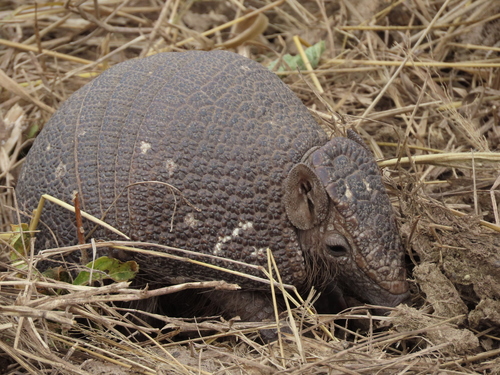
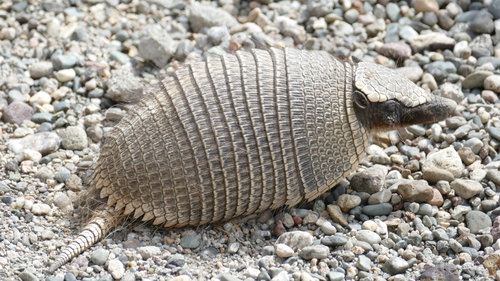
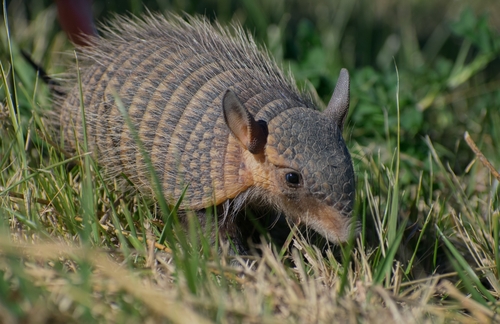
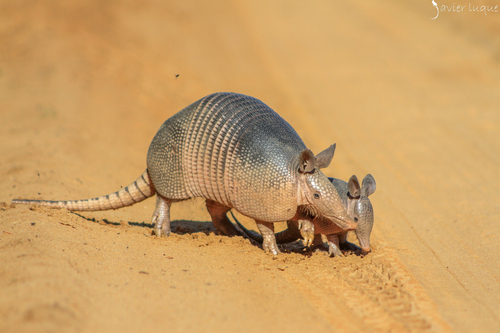
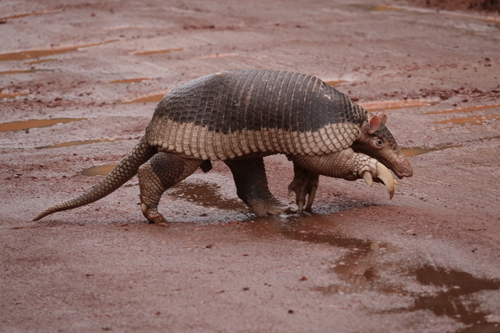
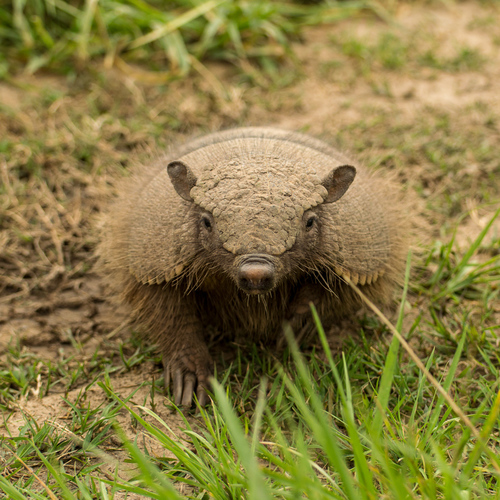
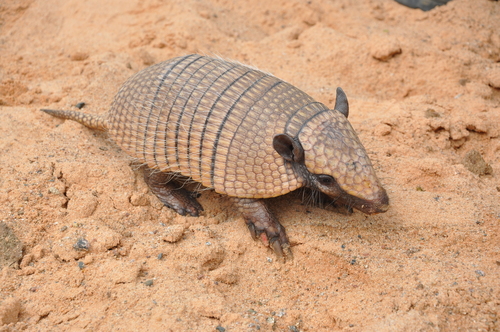
The six-banded armadillo, with the scientific name Euphractus sexcinctus (Linnaeus, 1758), is the largest species in the subfamily Euphractinae, which also includes the pichi and hairy armadillos. It is the third largest armadillo species overall, after the giant armadillo and the greater long-nosed armadillo. This armadillo typically has a head-and-body length between 40 and 50 centimeters (16 and 20 inches), and weighs between 3.2 and 6.5 kilograms (7.1 to 14.3 pounds). Its carapace ranges from pale yellow to reddish brown, and is never dark brown or black. The carapace is marked with equal-length scales, and has sparse buff to white bristle-like hairs; this differs from hairy armadillos, which have a dense covering of hairs. The shell narrows to 70 to 80 percent of its original width towards the top of the head, which is covered by plates arranged in a distinct pattern. Each of the six-banded armadillo's forefeet has five clear toes, each with a moderately developed claw, and the third claw is the longest. Like other euphractines and the pink fairy armadillo, the six-banded armadillo has a tympanic bulla, and its ears measure 32 to 47 millimeters (1.3 to 1.9 inches) in length. It has 9 pairs of teeth in the upper jaw and 10 pairs in the lower jaw; the teeth are large and strong, and chewing is supported by strong chewing muscles. A row of scutes, each 13.5–18.4 millimeters (0.53–0.72 inches) wide, runs along the back of the six-banded armadillo's neck. Its tail is 12–24 centimeters (4.7–9.4 inches) long, and the underside of the tail is covered by two to four bands of plates. Some of these plates have holes for scent gland secretions, a feature not seen in any other armadillo except some big hairy armadillos. The six-banded armadillo lives in savannas, primary forests, secondary forests, cerrados, shrublands, and deciduous forests. It can adapt to a wide range of habitats, and can even live on agricultural land; it has been recorded at elevations up to 1,600 meters (5,200 feet) above sea level. A study conducted in southeastern Brazil estimated the species' population density at 0.14 individuals per hectare. The same study found that the six-banded armadillo frequently displaces and is displaced by the sympatric southern naked-tail armadillo, and this dynamic is thought to support their coexistence. The six-banded armadillo has a broad distribution across South America: its range extends from Brazil and southern Suriname in the northeast, through Bolivia, Paraguay and Uruguay, to northern Argentina in the southeast. Its presence in Peru is considered unconfirmed. Multiple studies have documented different activity patterns for the six-banded armadillo: some studies classify it as diurnal, meaning it is most active during the day, while other studies find it is nocturnal, or most active at night. It is an alert animal; unlike other armadillos, it will flee when it senses danger, and will bite if handled. It is primarily a solitary animal, and six-banded armadillos only gather together to feed on carrion. A 1983 study in eastern Brazil measured the mean home range size of the six-banded armadillo as 93.3 hectares (0.360 square miles). It is an efficient digger, and digs U-shaped burrows with a single opening, most often in dry areas; these burrows may be either permanent or temporary shelters. The burrows can reach deep underground and aid the armadillo in foraging. A study that compared burrows dug by the giant, six-banded, southern naked-tailed and greater naked-tailed armadillos found that all the burrows had similar surrounding soil slopes, surrounding soil properties, and entrance directions. However, the groups differed in their preferred burrow locations and how much time they spent in the burrows. Burrows from different species could be easily distinguished by their dimensions. Burrows of the six-banded armadillo have a mean opening height of 19 centimeters (7.5 inches) and a mean opening width of 21 centimeters (8.3 inches). Further into the burrow, the width narrows to 10 centimeters (3.9 inches), while the height ranges from 16 centimeters (6.3 inches) to 21 centimeters (8.3 inches). Generally, burrows widen enough to allow the armadillo to turn around as depth increases. Unlike moles, which throw soil to the side while digging, the six-banded armadillo digs with its forefeet and throws soil behind itself with its hindfeet. Six-banded armadillos defecate outside of their burrows. Breeding behaviour of the six-banded armadillo has been observed in captive individuals. Births can occur throughout the year. After a gestation period of 60 to 64 days, the female gives birth to a litter of one to three young. Each newborn weighs 95 to 110 grams (3.4 to 3.9 oz), has a hairless, soft carapace, and can produce soft clicking sounds. The pregnant female builds a nest before giving birth; if disturbed, the mother will react aggressively and move her offspring. The newborn's eyes are closed at birth, and open between 22 and 25 days after birth. Weaning takes place at one month old, and juveniles reach maturity by nine months old. One captive six-banded armadillo lived for almost 18 years.