About Euphorbia polycarpa Benth.
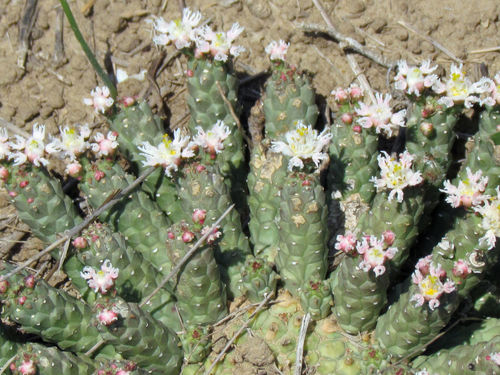
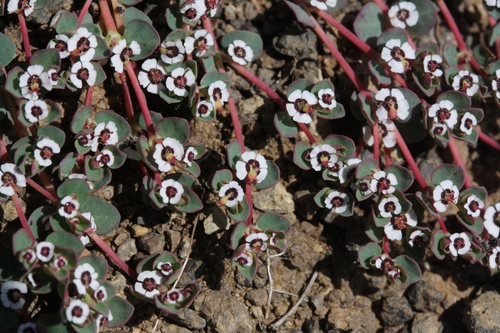
Euphorbia polycarpa Benth., formerly classified as Chamaesyce polycarpa, is a spurge species commonly known as smallseed sandmat. It is native to the southwestern United States and northern Mexico, where it grows particularly in deserts and other dry, sandy habitats. This is a perennial herb that produces trailing stems that spread along the ground to form a clump or mat, and may sometimes grow somewhat upright. Its individual leaves are each less than one centimeter long, with a round or oval shape and triangular stipules at their bases. What appears to be a single flower is actually an inflorescence made up of many male (staminate) flowers clustered around a single central female (pistillate) flower. The bracts surrounding this entire flower structure are white and resemble petals. The fruit is a thin spherical capsule less than 2 millimeters wide that forms layered over a seed. The genus name roots come from Greek: "Chamae" means "on the ground", referring to this species' low, spreading growth near the ground, and "Syke" comes from the Greek word for fig. Among the Zuni people, a warm gruel prepared with this plant and white cornmeal is consumed to promote milk flow.