About Euphorbia neriifolia L.
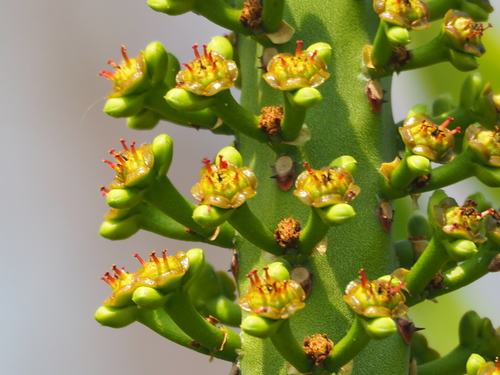
Euphorbia neriifolia L. is a large, cactus-like xerophytic succulent that grows as a highly branched tree, reaching up to 6.5 meters in height with a loosely branched crown. Its spread-out, upright branches are almost pentagonal, around 3 centimeters thick, and divided into sections by constrictions. The main trunk and larger branches are rounded; younger branches are somewhat whorled, unjointed, grey or light green, glabrous, 8–30 millimeters thick, and often leafless. The edges of the branches are covered in small, conical warts. It produces thick, fleshy alternate leaves that grow towards the ends of branches and persist longer on young shoots. Leaves are obovate, almost sessile, and can reach 30 centimeters in total length, but more typically measure 10–18 cm long by 3–7 cm wide, and can also be oblong or spatulate in shape. They have an attenuate base, entire margins, a rounded apex, and very short petioles 2–4 mm long. The species is deciduous: leaves persist through the main vegetation period, and fall in late summer and early autumn. Its thorn shields are triangular, and produce thorns up to 12 millimeters long. This plant is native to central India, Odisha, and the Deccan region of southern India, and is now naturalized in West Bengal, Sri Lanka, and across much of Southeast Asia, including Burma, Thailand, Vietnam, Malaysia (excluding Borneo), the Philippines, and New Guinea. It is also cultivated as a hedge and ornamental plant in other tropical regions. The leaves of Euphorbia neriifolia can be eaten raw or cooked, when boiled with syrup. Leaves and sliced branches can be processed into sweets similar to candied fruit. It is grown as a living fence to mark land boundaries or contain livestock. Its aromatic wood is used to make small objects such as knife handles. Latex from the plant is applied to cuts made by collectors on Palmyra palm bark, to prevent attacks by the red weevil. The latex is slightly irritating when it contacts skin and is toxic. It acts as a diuretic, purgative, rubefacient, and vermifuge, so it has been used to treat constipation, asthma, sore throat, and other conditions. The ancient practitioner Sushruta prescribed latex mixed with water to treat a range of abdominal conditions including jaundice and ascites, as well as skin diseases, urinary disorders, and even diabetes. It has also been used to treat hemorrhoids. Latex is applied directly to lesions to remove warts and other skin eruptions. Juice squeezed from heated leaves is used as a remedy for otalgia and otitis. The root and stem pulp are considered antiseptic. Traditional practitioners have used the plant's antibacterial activity to treat ulcers and dress wounds. The root acts as an antispasmodic, and when mixed with black pepper, it is applied to treat snake bites.