About Euphorbia milii Des Moul.
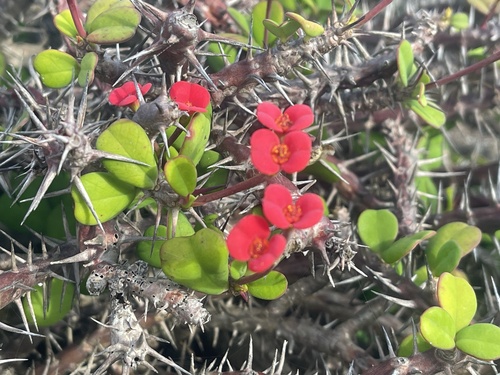
Euphorbia milii Des Moul. is a woody, succulent subshrub or shrub that reaches up to 1.8 m (5 ft 11 in) tall, with size varying by cultivar. Its stems are densely covered in spines, and growth habit varies by variety: some grow in a horizontal, sprawling, or prostrate form, while others grow nearly vertically. Some cultivars are valued for their thinner stems, while many, particularly Thai hybrids, grow much thicker, substantial stems that can reach several inches in diameter. The sharpness, bluntness, shape, and texture of the spines also vary by cultivar, just like the plant’s flowers and growth habit. On most varieties, spines grow up to 3 cm (1.2 in) long, and help the plant scramble over other vegetation, eventually forming a dense, impenetrable thicket. Fleshy green leaves, which grow up to 3.5 cm (1.4 in) long and 1.5 cm (0.59 in) broad, are mostly found on new growth, and multiple variegated varieties exist in cultivation. The plant’s actual flowers are small, and are subtended by a pair of prominent petal-like bracts that come in red, pink, or white, and reach up to 12 mm (0.47 in) broad. E. milii grows most vigorously between spring and summer, but produces flowers year-round. Extrafloral nectaries located at the involucre of this species were first reported by Teng and Hu in 2002. The sap of Euphorbia milii is moderately poisonous. Contact with skin or eyes causes irritation. If ingested, it leads to severe stomach pain, irritation of the mouth and throat, and vomiting. The toxic compounds responsible have been identified as phorbol esters. It is very toxic to domestic animals including horses, sheep, cats, and dogs, while it is only mildly toxic to humans, acting solely as an irritant. E. milii can be propagated from cuttings. It is not a hardy plant, and cannot tolerate temperatures below 10 °C (50 °F). In temperate regions, it must be grown under glass in full sun. Once all risk of frost has passed in summer, it can be moved outside to a sheltered location. Both the main species and the variety E. milii var. splendens have been awarded the Royal Horticultural Society's Award of Garden Merit. Wat Phrik in Thailand claims to host the world's tallest Christ thorn plant.