About Euphorbia geroldii Rauh
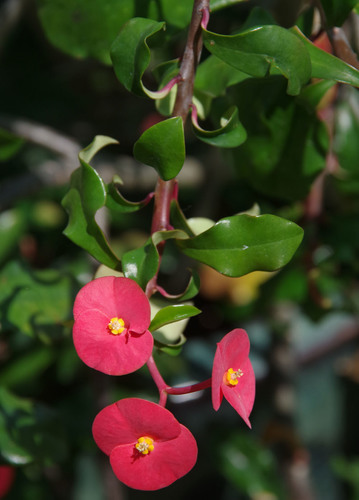
Euphorbia geroldii Rauh is a xerophytic succulent that grows as a richly branched shrub reaching up to 2 m (6.6 ft) tall. It has cylindrical woody branches that grow up to 2 cm (0.8 in) in diameter at the base. Its smooth, glossy, lanceolate leaves are arranged in loose spirals on new shoots, growing up to 8 cm (3.1 in) long and 3 cm (1.2 in) wide. These leaves are a glossy dark green with red margins, and are nearly sessile. The plant's toothed stipules measure 1 to 2 mm (0.04 to 0.08 in) long. It resembles Crown of Thorns (Euphorbia milii), but differs in having broader leaves, no thorns, and a preference for shadier growing conditions. This species is endemic to northeastern Madagascar, where it occurs across the coastal forest of Iharana in the Ambilobe region. Its natural habitats are subtropical or tropical dry forests, and the sandy areas of coastal forests. Euphorbia geroldii is threatened by habitat degradation, fire, and clearing for charcoal production, as well as collection for national and international horticultural trade. It is highly vulnerable to all forms of disturbance, including human-caused fires, and is primarily threatened by habitat loss. It is listed as critically endangered on the IUCN Red List. Euphorbia geroldii is a relatively fast-growing species cultivated as an ornamental plant, and is especially popular as a thornless houseplant. It is grown from cuttings, and its care needs match those of other shrubby Euphorbia species from tropical regions like Madagascar and central Africa; it is also one of the easiest of these species to grow. Hummingbirds are particularly attracted to this plant. Outdoors, it prefers semi-shade, while indoors it needs full to partial sun. Plants grown in shade must be gradually acclimated before being moved into full sunlight, because sudden exposure can cause severe leaf scorching. This species is especially tolerant of coastal conditions and salt spray, so it is an excellent choice for seaside plantings. Tall specimens will need staking, or they will become leggy. Pests and diseases such as mildew can develop when the plant is grown in very humid conditions.