About Euphonia trinitatis Strickland, 1851
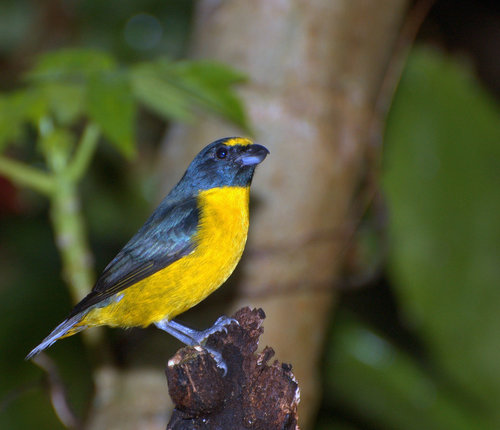
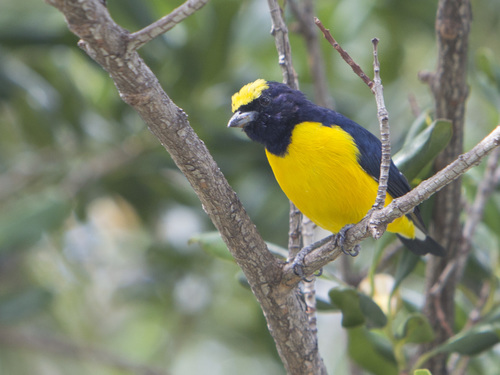
The Trinidad euphonia, scientifically named Euphonia trinitatis Strickland, 1851, is a small, stout, short-tailed passerine bird. It measures 9.7–11 cm (3.8–4.3 in) in length and weighs 8.8–14 g (0.31–0.49 oz), and shows clear sexual dimorphism in its plumage. Males have glossy blue-black plumage on the head, back, chin, and throat, paired with a bright yellow forehead, crown, and underparts. The basal half of the male’s rectrices and its underwing coverts are white; the white underwing coverts create a white stripe on the underwing during flight. Males also have white coloring on the inner webs of the outer two to three tail feathers, which appears as two large white ovals on the undertail, and the yellow color of the male’s crown extends well behind the eyes. Females have olive-green plumage on their upperparts and yellow-olive plumage on their underparts, with a grayer patch running down the center of the breast and abdomen, and bright yellow undertail coverts. Both sexes have dark brown irises, gray legs and feet, and a black bill with a white base on the lower mandible. This species is distributed across northern Colombia, northern Venezuela, and Trinidad. There is only a single record of the bird from Tobago, which is widely considered to be of a probable escaped cage bird. On Trinidad, the Trinidad euphonia occurs mainly in second growth and hill forest near mistletoe, and in cultivated areas with large trees; it can also be found in mangroves along the island’s west coast. On the South American mainland, the species lives in the tropical zone at elevations up to 1,100 m (3,600 ft), and is particularly common in arid regions. Its mainland habitats include dry forest, moist forest edges, light woodland, scrub, and cultivated areas. In moister forest types, the Trinidad euphonia is replaced by the purple-throated euphonia. There are a small number of exceptional, high-elevation, sight-only (undocumented) records of the species in Venezuela: one at 1,200 m (3,900 ft) and another at 1,450 m (4,760 ft). In terms of behavior and ecology, the Trinidad euphonia spends most of its time in treetops. It is usually seen in pairs or groups of up to eight individuals. While it rarely joins mixed-species foraging flocks, it will readily join mobs that harass snakes, owls, and other predators. This species is known to wander over wide areas.