About Euphonia chlorotica (Linnaeus, 1766)
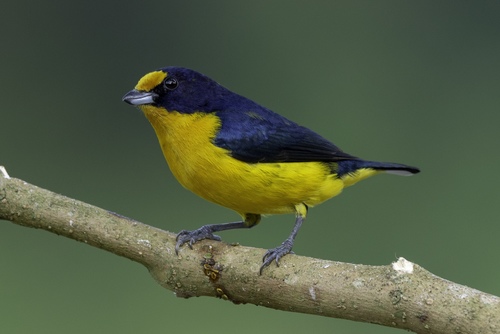
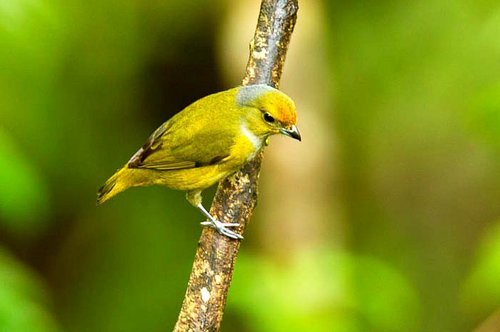
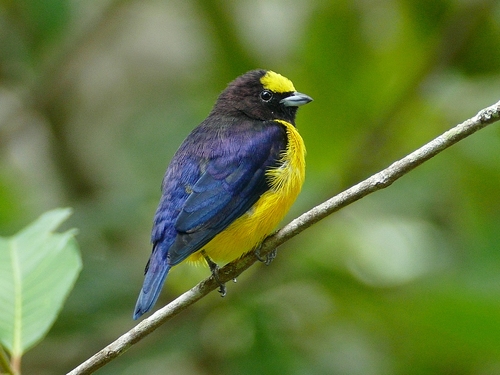
The purple-throated euphonia, with the scientific name Euphonia chlorotica, is a songbird species in the finch family Fringillidae. It was formerly classified in the Thraupidae family. This species is found in Argentina, Bolivia, Brazil, Colombia, Ecuador, French Guiana, Guyana, Paraguay, Peru, Suriname, Uruguay and Venezuela. Its natural habitats are subtropical or tropical moist lowland forests, as well as heavily degraded former forest. In 1760, French zoologist Mathurin Jacques Brisson published a description of the purple-throated euphonia in his work Ornithologie, using a specimen collected in Cayenne, French Guiana. Brisson gave it the French name Le tangara noir et jaune de Cayenne and the Latin name Tangara Cayanensis Nigrolutea. Even though Brisson created these Latin names, they do not follow the binomial naming system and are not recognized by the International Commission on Zoological Nomenclature. In 1766, naturalist Carl Linnaeus updated his Systema Naturae for its twelfth edition, adding 240 species that Brisson had already described, including the purple-throated euphonia. Linnaeus wrote a brief description of the species, coined the binomial name Tanagra chlorotica, and cited Brisson’s earlier work. The specific epithet chlorotica comes from the Ancient Greek term khlōrotēs, which means "greenness". This species is now one of 25 Neotropical species placed in the genus Euphonia, which was first introduced by French zoologist Anselme Gaëtan Desmarest in 1806. Five subspecies of Euphonia chlorotica are currently recognized. E. c. cynophora, described by Oberholser in 1918, occurs in east Colombia, south Venezuela and north Brazil. E. c. chlorotica, originally described by Linnaeus in 1766, is found in the Guianas and northeast and east Brazil. E. c. amazonica, described by Parkes in 1969, occurs in central north and central Brazil. E. c. taczanowskii, described by P.L. Sclater in 1886, is found in Peru and north Bolivia. E. c. serrirostris, described by d'Orbigny & Lafresnaye in 1837, ranges from southeast Bolivia and southeast Brazil to central north Argentina.