About Eupherusa eximia (Delattre, 1843)
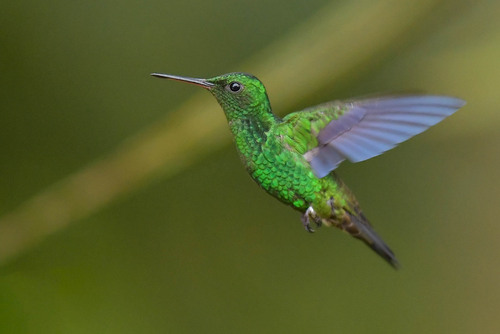
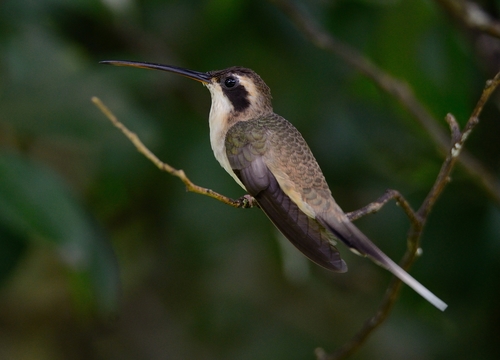
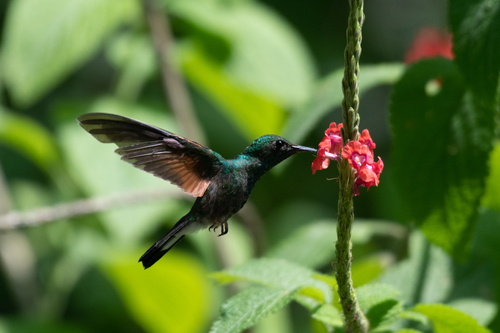
Eupherusa eximia, commonly called the stripe-tailed hummingbird, is 9 to 10.5 cm (3.5 to 4.1 in) long and weighs an average of 4–4.5 g (0.14–0.16 oz). All subspecies of both sexes have a straight black bill. The nominate male has bright metallic grass green upperparts, which are more bronzy on the uppertail coverts. Cinnamon rufous secondaries form a visible patch on the folded wing. Its three inner pairs of tail feathers are dark bronze green; the outer two pairs have black outer webs and white inner webs with black tips, which gives the species its English common name. The nominate male's underparts are bright metallic grass green with white undertail coverts. The female also has grass green upperparts, while its underparts are brownish gray with metallic green spots on the sides. Its tail has a similar pattern to the male's, with the addition of dusky to black tips on the inner feathers. Males of the subspecies E. e. nelsoni are larger than the nominate subspecies. Their underparts are more yellowish green, and the black tips of their outer tail feathers are less sharply defined. Males of E. e. egregia are also larger than the nominate. On E. e. egregia males, black on the outer web of the two outermost pairs of tail feathers is limited to the tip. For female E. e. egregia, the outermost pair of tail feathers is usually entirely white. Regarding distribution and habitat, subspecies E. e. nelsoni is the northernmost subspecies of the stripe-tailed hummingbird, found in the eastern Mexican states of Veracruz and Oaxaca. The nominate E. e. eximia ranges from Chiapas in extreme eastern Mexico south through southern Belize, Honduras, and El Salvador into central Nicaragua. Both E. e. nelsoni and the nominate subspecies are limited to the Caribbean slope of the highlands. Subspecies E. e. egregia is found on both the Caribbean and Pacific slopes in Costa Rica and western Panama. The stripe-tailed hummingbird inhabits the edges and interior of humid montane, semi-deciduous, and pine-oak forest, and also occurs in plantations. Its elevational range is from near sea level to 1,800 m (5,900 ft) in Mexico, from 300 to 1,800 m (980 to 5,900 ft) in Honduras, and between 300 and 2,450 m (980 and 8,000 ft) in Costa Rica.