About Euphausia superba Dana, 1850
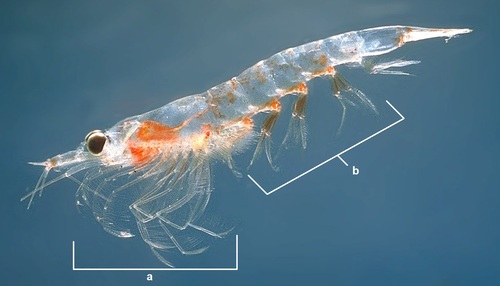
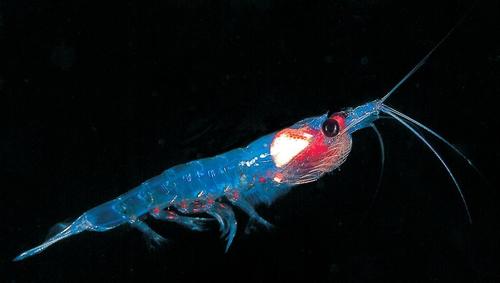
Antarctic krill, scientifically named Euphausia superba Dana, 1850, is a krill species native to the Antarctic waters of the Southern Ocean. It is a small, swimming crustacean that lives in large schools called swarms, which sometimes reach densities of 10,000 to 30,000 individual krill per cubic metre. It feeds directly on tiny phytoplankton, using the primary production energy that phytoplankton capture from the sun to support its pelagic life cycle. Adult Antarctic krill grow to 6 centimetres (2.4 inches) in length, weigh up to 2 grams (0.071 ounces), and can live for as long as six years. It is a key species in the Antarctic ecosystem. In terms of total biomass, E. superba is one of the most abundant animal species on Earth, with an approximate cumulative biomass of 500 million metric tons (equal to 550 million short tons or 490 million long tons).
Antarctic krill has a circumpolar distribution, found across the entire Southern Ocean and reaching as far north as the Antarctic Convergence. At the Antarctic Convergence, cold Antarctic surface water sinks beneath warmer subantarctic waters. This convergence front lies roughly at 55° south; the area of the Southern Ocean from this front to the Antarctic continent covers 32 million square kilometres, which is 65 times the size of the North Sea. In winter, more than three-quarters of this area becomes covered by ice, while 24,000,000 square kilometres (9,300,000 square miles) remains ice free in summer. Water temperatures in this region range from −1.3 °C to 3 °C (29.7 °F to 37.4 °F).
The Southern Ocean contains a system of currents. The West Wind Drift moves surface water eastward around Antarctica, while the East Wind Drift flows counterclockwise close to the continent. Large eddies form at the front between these two current systems, for example in the Weddell Sea. Krill swarms travel with these water masses, creating a single continuous krill stock around Antarctica with ongoing gene exchange across the entire range. Little is currently known about krill's precise migration patterns, because individual krill cannot yet be tagged to track their movements. The largest krill swarms are visible from space and can be tracked by satellite. One recorded swarm covered 450 square kilometers (170 square miles) of ocean surface, extended down to 200 meters (660 feet) deep, and was estimated to hold over 2 million tons of krill. Recent research indicates krill do not only drift passively with these currents—they actually modify the currents themselves. Through daily vertical movement through the water column on a 12-hour cycle, krill swarms play a major role in mixing deeper, nutrient-rich water with nutrient-poor surface water.
Antarctic krill's main spawning season runs from January to March, and spawning occurs both above the continental shelf and in the upper regions of deep open ocean areas. Like all krill, the male attaches a spermatophore to the female's genital opening. The male's first pleopods, the legs attached to the abdomen, are specialized as mating tools for this process. Females lay 6,000 to 10,000 eggs at a time, which are fertilized as they exit the genital opening.
The classical hypothesis of Marriosis De' Abrtona, developed from results of an expedition by the British research vessel RRS Discovery, describes subsequent egg development as follows: Gastrulation, the process that develops the egg into an embryo, begins as the 0.6 mm (0.024 in) eggs sink toward the seabed. On the continental shelf, eggs sink to the bottom; in open ocean areas, they reach depths of around 2,000 to 3,000 metres (6,600 to 9,800 ft) before development completes. Eggs hatch into nauplius larvae. After the nauplius moults into a metanauplius, young krill begin migrating toward the surface in a movement called developmental ascent. The next two larval stages, second nauplius and metanauplius, do not feed and rely on remaining yolk reserves for nourishment. Young krill complete their ascent to the surface after three weeks. They can occur in enormous numbers, reaching densities of two individuals per litre at 60 m (200 ft) water depth. As they grow, krill pass through additional larval stages: second and third calyptopis, then first to sixth furcilia. These stages are marked by increasing development of additional legs, compound eyes, and setae (bristles). When krill reach 15 mm (0.59 in) in length, juvenile krill already have the same general form as adult krill. Krill reach sexual maturity after two to three years. Like all crustaceans, krill must moult to grow. Approximately every 13 to 20 days, krill shed their chitinous exoskeleton, which is left behind as exuvia.
Antarctic krill is the keystone species of the Antarctic ecosystem beyond the coastal shelf, and it is a critical food source for many animals including whales, multiple seal species (leopard seals, fur seals, and crabeater seals), squid, icefish, penguins, albatrosses, and many other bird species. Crabeater seals have evolved specialized multilobed teeth as an adaptation to feed on this abundant prey; their unusual teeth work as a sieve to strain krill from water. The detailed function of this dentition is still not fully understood. Crabeater seals are the most abundant seal species on Earth, and 98% of their diet consists of E. superba. These seals consume over 63 million tonnes of krill each year. Leopard seals have similar specialized teeth, and krill makes up 45% of their diet. All seal species combined consume 63 to 130 million tonnes of krill yearly, all whales consume 34 to 43 million tonnes, birds consume 15 to 20 million tonnes, squid consume 30 to 100 million tonnes, and fish consume 10 to 20 million tonnes. Total annual consumption of Antarctic krill by all predators adds up to 152 to 313 million tonnes.
The size difference between Antarctic krill and its prey is unusually large: it generally takes three or four trophic steps to go from 20 μm phytoplankton cells to a krill-sized organism (through small copepods, large copepods, mysids, leading to 5 cm fish). E. superba lives only in the Southern Ocean. In the North Atlantic, the dominant krill species is Meganyctiphanes norvegica, and in the Pacific Ocean the dominant krill species is Euphausia pacifica.
The transparent body wall of E. superba often allows its gut to be seen shining green from the outside. This species feeds predominantly on phytoplankton, especially very small 20 μm diatoms, which it filters from water using a feeding basket. The glass-like silica shells of diatoms are cracked in the krill's gastric mill, then digested in the hepatopancreas. Krill can also catch and consume copepods, amphipods, and other small zooplankton. The krill gut is a straight tube, and krill have relatively low digestive efficiency, so a large amount of carbon remains in their feces. Antarctic krill primarily produces chitinolytic enzymes in the stomach and mid-gut to break down the chitinous spines on diatoms, and additional enzyme profiles can vary due to their broad diet. Cannibalism has been observed in krill kept in aquaria. When krill do not receive enough food, they shrink in body size after moulting—a trait that is unusual for animals of this size. This is likely an adaptation to the seasonal availability of their food, which is limited during dark winter months under sea ice. However, krill's compound eyes do not shrink when the body shrinks, so the ratio of eye size to body length is a reliable indicator of starvation. A krill with enough food has eyes proportional to its body length, while a starving krill has eyes that appear disproportionately large for its body.