About Euphagus cyanocephalus (Wagler, 1829)
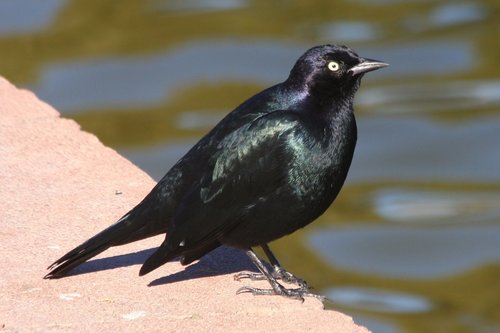
Description: Adult male Brewer's blackbirds have black plumage with an iridescent purple head and neck, and glossy bluish-green highlights on the rest of the body. Their feet and legs are black, and their eyes are bright yellow. Females are brownish-grey with faint traces of the male's iridescence, and have dark brown eyes. Overall, this species resembles the rusty blackbird, the eastern member of the same genus. However, Brewer's blackbird has a shorter bill, and the male's head is iridescent purple. It is often mistaken for the common grackle, but has a shorter tail. Its call is a sharp check that also helps distinguish it. This species belongs to a different family than the Eurasian blackbird.
Habitat: Their breeding habitat consists of open and semi-open areas, often near water, across central and western North America. They are also very common in parking lots or around schools, and easily acclimate to human presence. They can live at elevations ranging from below sea level in Southern California up to 8,000 feet. They are able to survive in diverse environments, including marshlands and forests. Many populations in western North America are permanent residents. Other populations migrate to the Southeastern United States and Mexico in spring. The species' range has been expanding eastward in the Great Lakes region, and its habitat expansion occurred as recently as the 20th century.
Reproduction: Mated pairs do not stay together year round, but the same pair typically reunites for each mating season. Both parents share responsibility for feeding chicks. During courtship, male Brewer's blackbirds puff up their feathers, spread their wings and tail to appear as large as possible, and point their beak forward. Clutch size varies, usually between 3 and 7 eggs. Eggs are typically tan with darker speckles distributed across the shell, for camouflage. The female primarily incubates the eggs for 12 to 14 days. Chicks leave the nest just 2 weeks after hatching. Nests are built in colonies of up to 30 pairs, rather than in isolated locations. Pairs prefer to nest in treetops 20 to 40 feet high. However, colonies living near water may also nest in reeds and other freshwater plants. Nests are constructed from local materials including reeds, sticks, and hair. The female builds the nest into a cup shape, and binds it together with mud or other binding materials. The nest's color usually matches the eggs and the surrounding environment, which is crucial for survival. Newly hatched Brewer's blackbird chicks do not open their eyes immediately, and hatch without feathers.