About Euphaedra harpalyce Cramer, 1779
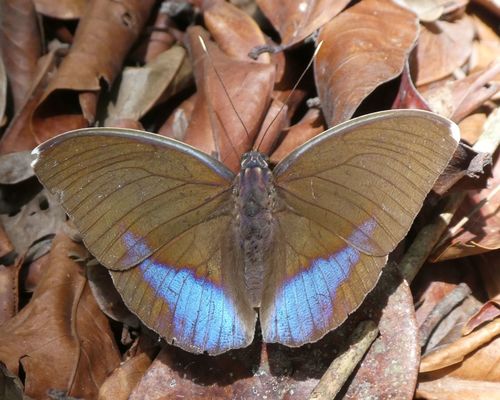
This species is Euphaedra harpalyce Cramer, 1779. For the nominal type-form of E. harpalyce: the upper side of both wings is uniformly black-brown. The forewing has a small white apical spot, and the hindwing has a bright blue transverse band. This blue band is broad at the anal angle, narrows toward the anterior, ends at vein 6 or 7, and sometimes extends to varying degrees onto the forewing as well. The underside is rather uniformly light green or grey-green, with 1 to 3 black dots in the wing cells. In the type-form, the forewing's subapical band is completely absent in males, and very narrow and yellowish in females. This type-form occurs from Sierra Leone to Cameroons. For the aberration ab. lakuma Btlr., the forewing's subapical band is very narrow in males, but 4–5 mm broad in females. E. spatiosa Mab. is treated here as a synonym and subspecies of E. harpalyce. On E. spatiosa, the upper side of both wings is uniformly dark olive-brown; the apical half of the forewing is blackish, with a yellow subapical band and a white apical spot. The underside is green, with one black dot in the wing cells (occasionally 2 or 3), and two dull, dark, not very distinct transverse bands beyond the middle of the wing. The forewing's subapical band only shows through faintly on the underside. Females of this taxon can reach a wing expanse of 100 mm, and are the largest of all Euphaedra species. This subspecies/synonym occurs from Cameroons to the Congo and Uganda.