About Euphaea dispar Rambur, 1842
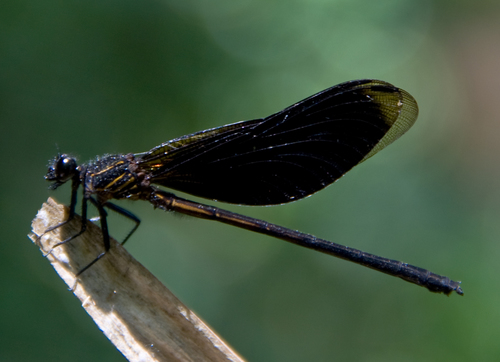
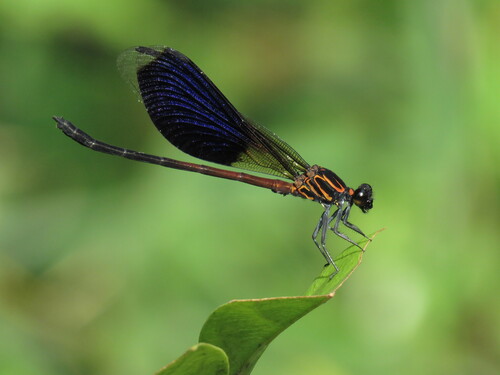
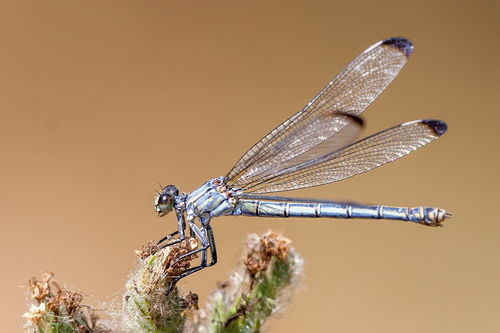
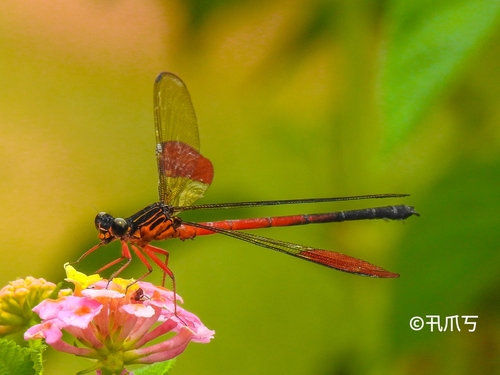
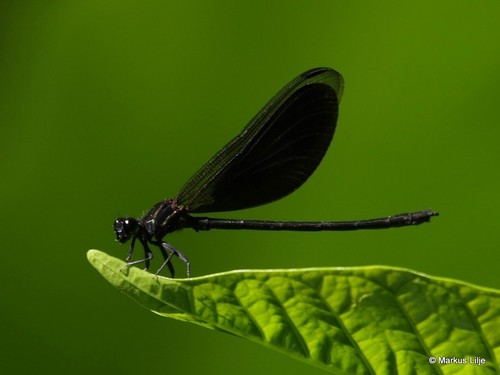
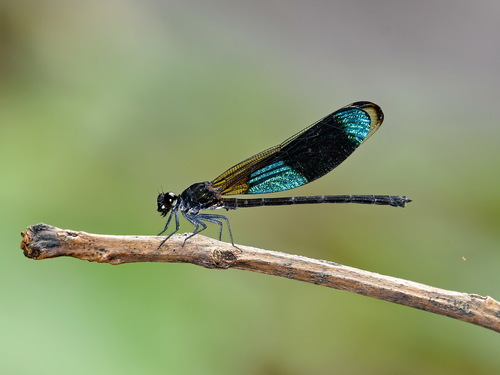
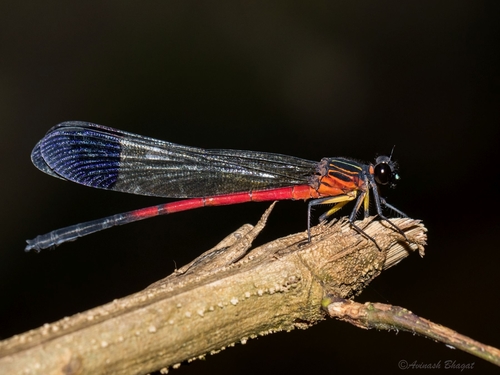
Euphaea dispar Rambur, 1842 is a medium-sized damselfly. Males have a black head, pale grey eyes with a brown cap, and a black thorax marked with bright ochreous-red antehumeral and humeral stripes; the base of the thorax's lateral sides is red. All legs are yellow at the base, with dark remaining segments. Its wings are narrower than those of Euphaea cardinalis. Fore-wings are transparent, with black coloration at the extreme apices. Hind-wings are transparent, but nearly one third of the wing measured from the apex is broadly black. The abdomen is bright red up to segment 6; from the apical third of segment 6 to the final end segment, the abdomen is black. Anal appendages are black. Males of this species can be easily distinguished from other Euphaea species by the small black tips on the apices of their fore-wings. Females are short and robust, and the ochreous-red markings seen in males are replaced with yellow colors in females. All wings are transparent, and are infused with black in adult females. The female abdomen is black with yellow lateral stripes extending up to segment 6, and these yellow lateral stripes continue on to segment 7. Segment 8 has a narrow yellow apical annule, and segment 9 has a broad yellow apical annule, which covers the dorsal half. This species breeds in streams that flow through evergreen forests. Males are typically found perched on twigs hanging above the water or on rocks.