About Eupetomena macroura (J.F.Gmelin, 1788)
The swallow-tailed hummingbird, scientific name Eupetomena macroura (J.F.Gmelin, 1788), has a total length of 15–17 cm (6–6+1⁄2 inches), with nearly half of this length made up by its tail. It weighs up to 9 g (0.32 oz), making it a relatively large hummingbird; across much of its range, it is the largest species of typical hummingbird. Its wings are nearly 8 cm long, which is quite large for a hummingbird of its size, while its bill measures roughly 21 mm (0.83 in) — an average absolute length that is no longer than the bills of many smaller related hummingbird species.
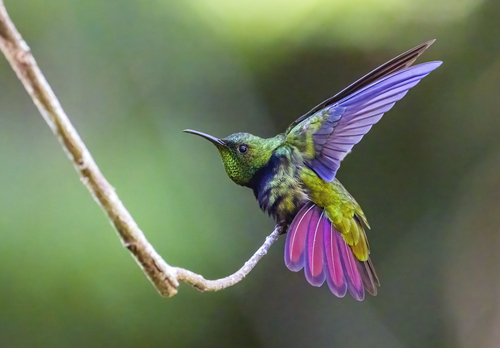
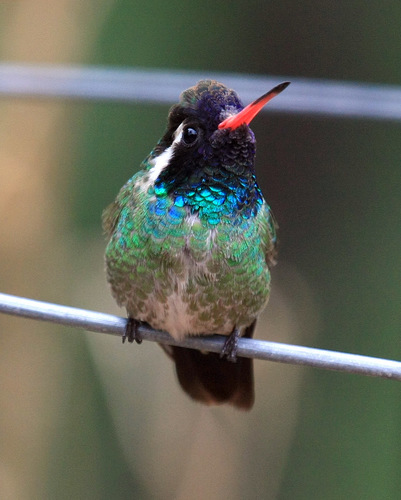
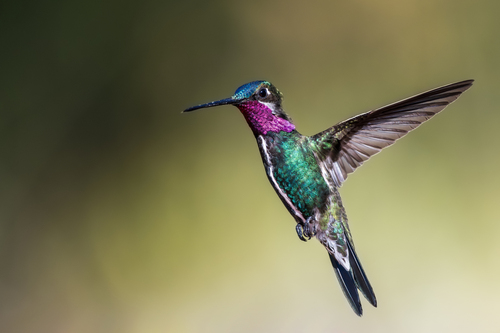
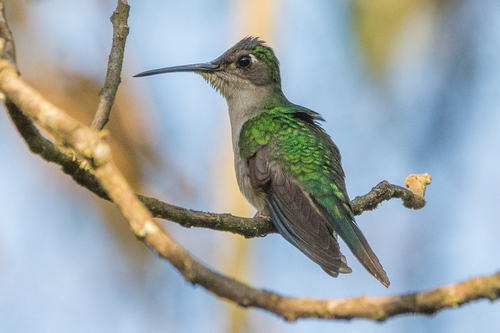
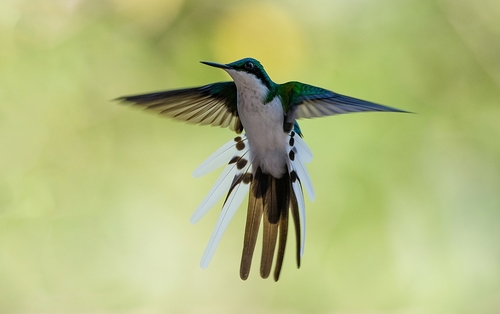
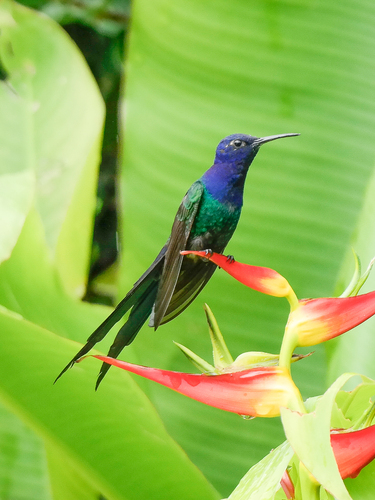
This species has brilliant iridescent green plumage, with blue coloring on its head, upper chest, tail, and vent. The tiny white spot behind the eye common to most hummingbirds is often not visible in this species, but the well-developed white ankle tufts common to the Trochilinae subfamily are clearly present. Its flight feathers (remiges) are blackish-brown, and it has a slightly decurved, medium-long black bill. The sexes are very similar in appearance, but on average, females are about one-fourth smaller and slightly duller than males. Immature birds look similar to females, but their heads are particularly dull with a brownish tinge.
Subspecies of Eupetomena macroura vary mainly in the hue of their plumage. The blue sections of plumage range from green-tinged blue to ultramarine to deep royal blue, while the green sections range from golden bronzy-green to deep bottle-green to blue-tinged green. The nominate subspecies and E. m. simoni have wide geographic ranges, while the other subspecies are more localized endemics. For E. m. hirundo, the blue coloring is quite dull, and its tail is less deeply forked. E. m. simoni is the bluest subspecies, with dark royal blue blue parts and blue-tinged green parts. E. m. bolivianus is the greenest subspecies, with a head that is more green than blue and pure bright green green sections. E. m. cyanoviridis is another very green subspecies, with green-tinged blue sections and golden bronzy green green sections.
The vocalizations of this species include relatively loud psek notes and weaker twitters. A tik call is given when the bird is excited or alarmed. The swallow-tailed hummingbird is almost always easy to identify, though it is occasionally confused with the male violet-capped woodnymph (Thalurania glaucopis). The violet-capped woodnymph only has a blue cap, however, with the rest of its head the same green as its belly.
Most of the swallow-tailed hummingbird's range covers the Caatinga and Cerrado regions of Brazil, plus adjacent areas of northern and eastern Bolivia, and far northern Paraguay. Along coastal regions, it occurs from French Guiana in the north to Santa Catarina, Brazil, in the south. It generally avoids the rainforest that covers most of the Amazon Basin, only extending locally into this region along the southern and eastern edge, in the relatively open habitats along the lowermost sections of the Amazon River (including Marajó Island), upstream to around the Tapajós River, and in isolated enclaves of woodland or savanna-like habitats within the Amazon. These isolated enclaves include the so-called "Amazonian Caatinga" in south-eastern Peru (upper Urubamba River and Pampas del Heath), southern Suriname (Sipaliwini Savanna), central Brazil, and northern Bolivia.
The swallow-tailed hummingbird can live in almost any semi-open habitat, including gardens and parks within major cities like Rio de Janeiro and São Paulo. It avoids the interior of humid forest, but does occur in forest openings or along forest edges. It is most common in savanna-like vegetation. It is generally a lowland species, but can be found locally up to 1,500 m (4,900 ft). It is not a true migrant, but some populations move a short distance north or south during the dry winter months.
Across most of its range, it is one of the most common hummingbird species, though it is generally uncommon in outlying regions, especially in wetter areas. In southern Brazil, its population is apparently increasing and it has expanded its range over recent decades. The IUCN lists it as a Species of Least Concern. Up to 1970, it was frequently exported for the cage bird trade. Like other hummingbirds, it is now listed on CITES Appendix II, and its trade is restricted. Hummingbirds are generally difficult to keep in captivity; while this species is fairly hardy, it has been noted that abandoned young may die even when given optimal care during hand-rearing.
This hummingbird is aggressive and will defend rich food sources from other nectarivores. Due to its size, it is generally dominant over other hummingbird species. It will attack even much larger birds by diving at them when they perch. Especially during breeding season, the swallow-tailed hummingbird will dive-bomb birds twice its own length or more, such as Campo flickers (Colaptes campestris), curl-crested jays (Cyanocorax cristatellus) or smooth-billed anis (Crotophaga ani), until the larger birds leave. When disturbed by much larger birds such as Guira cuckoos (Guira guira) or hawks, it will usually only give warning calls, but one female swallow-tailed hummingbird has been observed attacking a Swainson's hawk (Buteo swainsonii) — which weighs more than a hundred times as much as the hummingbird — in mid-air.
It also gives warning calls to mammalian carnivores and humans, though in urban environments this hummingbird may tolerate human observers for long periods of time, even when nesting, if observers stay at least 10 meters away. A study of a nest in urban São Paulo observed that a mother swallow-tailed hummingbird drove away ruddy ground doves (Columbina talpacoti) that were attempting to nest nearby. These small doves are far more placid, slow-moving, and heavier than the hummingbird, and are often prey for smaller carnivores; chasing them away would make the area around the hummingbird's nest less attractive to these predators. Smaller mammals, such as the common marmoset (Callithrix jacchus), may occasionally plunder swallow-tailed hummingbird nests, despite the parent birds' attempts to defend their young. In at least some situations, Philornis botfly larvae heavily infest nestling swallow-tailed hummingbirds, and a considerable number of nestlings are killed by these parasites.
The swallow-tailed hummingbird mainly forages at mid-levels of vegetation, but it will use good food sources from any height from near ground level up to the tops of trees. It feeds chiefly on flower nectar, particularly from plants in the families Fabaceae, Gesneriaceae, Malvaceae (especially Bombacoideae and Malvoideae), Myrtaceae, Rubiaceae, and epiphytic Bromeliaceae. It is not a highly specialized feeder, and has also been recorded feeding on plants from other families, such as Asteraceae or Caryocaraceae. It uses flowers from both native plants and some introduced ornamental plants. It will also catch and eat insects via hawking. In south-eastern Brazil, where it is plentiful even in urban parks and gardens, it is commonly attracted to artificial hummingbird feeders.