About Eupatorus gracilicornis Arrow, 1908
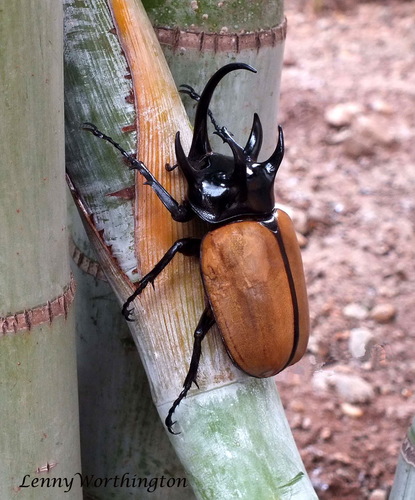
Eupatorus gracilicornis, commonly called the five-horned rhinoceros beetle, is a beetle species that has four large horns on its prothorax and one extra-long horn on its head. This species belongs to Dynastinae (rhinoceros beetles), a subfamily of the scarab beetle family Scarabaeidae. Five-horned rhinoceros beetles have been recorded in China, India, Myanmar, Thailand, Laos, and Vietnam. The beetle has a shiny jet-black body, with yellow or gold colored elytra (fore wings). Its body is covered by a thick exoskeleton; a pair of thick wing covers sits over a second set of membranous wings underneath, which allows the beetle to fly. Flight is not very efficient for this species, however, due to its large size. The flying season for this beetle usually falls in September, when most males emerge to wait for mating. Adult beetles measure between 50 and 95 mm in length. As larvae, five-horned rhinoceros beetles feed on rotten wood. Adult beetles eat nectar, plant sap, and fruit. This species was first formally described by British entomologist Gilbert John Arrow in 1908.