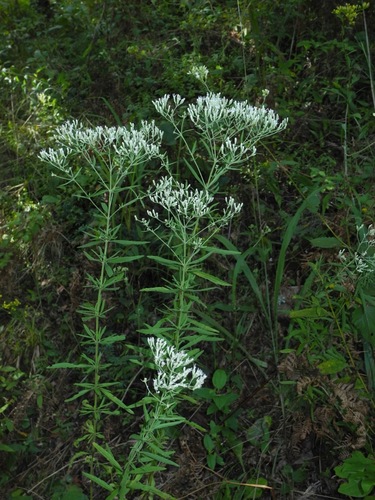
About Eupatorium torreyanum Short & Peter
Eupatorium hyssopifolium, commonly called hyssopleaf thoroughwort, is a fall-blooming herbaceous plant native to North America. Like other species in the genus Eupatorium, it produces inflorescences that hold many very small flower heads; each flower head contains 5 white disc florets and no ray florets. The plant reaches a height of 0.5 to 1 meter (20 to 40 inches), which places it toward the shorter end of the height range seen for Eupatorium species. Individuals classified as E. hyssopifolium may be either diploid or polyploid, and some appear to originate from past hybridizations with Eupatorium serotinum. Hybrids between E. hyssopifolium and E. album, as well as between E. hyssopifolium and E. linearifolium, are also thought to exist. The hybrid Eupatorium torreyanum (the species with scientific name Eupatorium torreyanum Short & Peter) is similar to E. hyssopifolium, but it is a hybrid of E. serotinum and Eupatorium mohrii. Two varieties of Eupatorium hyssopifolium are recognized: Eupatorium hyssopifolium var. hyssopifolium, which has leaves 2–5 mm wide, and Eupatorium hyssopifolium var. laciniatum A.Gray, which has leaves 5–15 mm wide. Eupatorium hyssopifolium is distributed across much of the eastern and south-central United States, ranging from Massachusetts west to Wisconsin, and south to Texas and Florida. It is listed as endangered in the state of Ohio. It grows in moist soils, and can be found in woodlands, oak savannas, pastures, fields, roadsides, and disturbed areas, growing on both acidic and calcareous substrates. Ecologically, Eupatorium hyssopifolium becomes more abundant after fire disturbance, and is most common in habitats that have short fire return intervals. Medicinally, Eupatorium hyssopifolium can be applied externally to treat insect and reptile bites. It can also be planted near crops to attract beneficial insects.