About Eupatorium serotinum Michx.
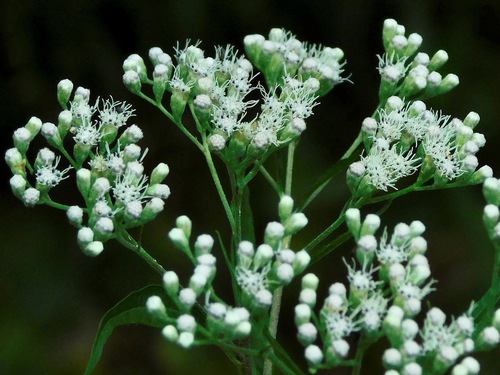
Eupatorium serotinum, commonly called late boneset or late thoroughwort, is a perennial herbaceous fall-blooming plant native to North America. Its range covers most of the eastern United States, where it occurs in every coastal state from Massachusetts to Texas, and extends inland as far as Minnesota and Nebraska. One small population has been reported in the Canadian province of Ontario, and there are additional reports of the species growing on the south side of the Río Grande in northern Mexico. Like other species in the genus Eupatorium, Eupatorium serotinum grows 1 to 2 meters (40 to 80 inches) tall. Its leaves are typically ovate with serrate margins, and are arranged alternately along the stem, though they may grow opposite at some upper stem nodes. The inflorescence is a flat-topped corymb made up of many small white flower heads; these heads contain 9 to 15 disc florets and no ray florets. Eupatorium serotinum grows in open sites, which may be either dry or moist, and it can hybridize with Eupatorium perfoliatum as well as other members of the genus Eupatorium. Unlike other wind-pollinated plants in this genus, E. serotinum is pollinated by insects. It produces late-season nectar for monarch butterflies, and evidence indicates that pyrrolizidine alkaloids produced by Eupatorium serotinum are beneficial to monarch butterflies.