About Eupackardia calleta Westwood, 1854
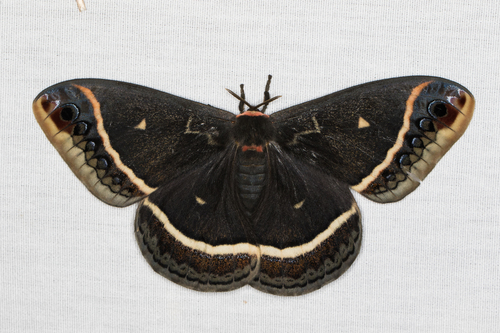
The calleta silkmoth (Eupackardia calleta Westwood, 1854) has distinct physical traits across its life stages. Adult moths have black bodies, with a red collar and red coloration on the back of the thorax. Their wingspan measures 8 to 11 centimetres; the wings are black with noticeable white post-median lines that are wider on females. Some individuals have large triangular white spots on the wings, while others do not. Larvae (caterpillars) are typically bright green with white stripes, and have sets of black spike-like scoli with blue and orange bases, though coloration may vary. Their bright coloration comes from biogenic chemicals that help repel predators. This species is distributed across southern Texas, Arizona, New Mexico, Mexico, and Guatemala. It inhabits dry deserts, thorn scrubs, and the foothills and canyons of desert mountain ranges. Flight seasons vary by region: in the southeastern mountains of Arizona, adults are most commonly seen from July to August; from central Arizona to Mexico, they are seen from October to January; in South Texas, they are seen from September to November and March to April. Adult E. calleta emerge in the evening, and may mate as early as 7:30 am the following morning. Males are diurnal, while females are nocturnal. Females begin laying eggs at dusk on the same day they emerge, depositing eggs in clumps on the surface of host plant leaves. Caterpillars can spray a defensive secretion from their integumental glands. Young caterpillars in the 1st to 3rd larval stages feed in groups, while older 4th and 5th stage caterpillars typically feed alone. Cocoons are spun near the ground in shaded areas, and attached to a twig with a short silken loop. The cocoons of Eupackardia calleta are commonly used to make ankle rattles and medicinal necklaces for use in certain American Indian ceremonies. For example, the Yaqui Indians of Arizona and Mexico refer to these rattles as "tenabares" or "tenevoim". The rattles are made in pairs, and worn around the ankles or both lower legs.